
West Facing House Main Door Pada — The Complete Vastu Guide
On a west facing house, which of the eight padas your door sits on decides far more than the direction itself. Here is the full pada table with every name, the honest answer on whether a west facing house is good or bad, and every fix that needs no demolition.
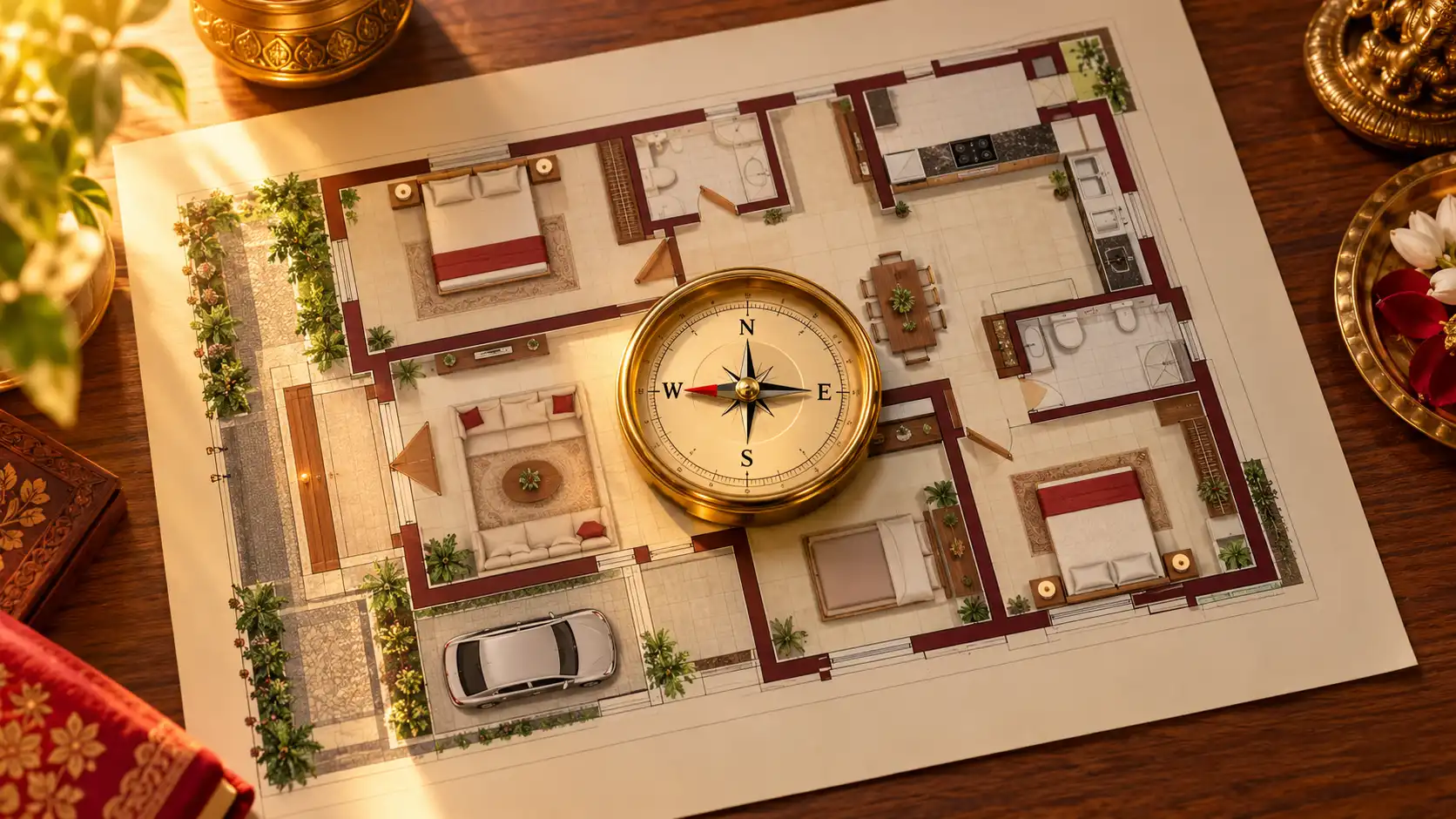
Is West Facing House Good or Bad? The Honest Answer
West facing homes sit in an odd middle position. Nobody warns you away from them as loudly as they do from south facing ones, yet buyers still hesitate, and resale agents still mention it in a lowered voice. So — is west facing house good or bad? Neither, by default. No classical Vastu text declares the west inauspicious. The west is the direction of Varuna, the guardian of water, rain and the cosmic order, and its planetary association is Saturn, the planet of patience, structure and long effort. Neither of those is a sign of misfortune.
That single question is really five smaller ones. This is the order an experienced consultant checks them in, and the order we recommend you check them in too:
| What decides it | Good when | Problem when |
|---|---|---|
| Main door pada | Sugriva, Pushpadanta or Varuna | Pitru, Dauvarika, Asura, Shosha or Papayakshma |
| Plot slope | Higher in the south and west, lower towards the north and north-east | Ground falling towards the west road |
| North-east zone | Open, light, uncluttered | Toilet, store, staircase or heavy clutter |
| Kitchen | South-east, or north-west as the second choice | North-east or the centre |
| Master bedroom | South-west | North-east or north-west |
Four of these five can be checked in a single visit, and most of them can be corrected afterwards. That is why the honest answer to whether a west facing home is good or bad is: it depends on details, not on the compass alone.
The practical advantages nobody mentions
- Bright, warm evening light in the living areas — the hours most working families are actually at home.
- Mornings stay cool on the entrance side, which is comfortable through most of the year in north India.
- Because of the belief, west facing units are often priced a little below east and north facing ones in the same project.
- Traditionally the west is associated with gains that come through steady, sustained effort — a good fit for business owners and professionals.
The practical disadvantage everyone should plan for
The real issue with a west facing home is not spiritual; it is the afternoon sun. In Delhi NCR the west wall takes the full force of the summer sun from about two in the afternoon until sunset, and rooms on that side can stay warm well into the night. The good news is that the traditional Vastu advice for the west and modern building practice say exactly the same thing: keep the west wall thicker and more solid, keep large glass openings to a minimum on that side, and shade it with trees, a verandah, a pergola or external blinds.
That overlap is not a coincidence. Much of what Vastu prescribes for the west is climate design that predates air-conditioning. When a client tells us their west facing home “feels heavy” in summer, the first thing we check is not the pada — it is how much unshaded glass faces the setting sun.
Why the West Carries a Mixed Reputation
The reputation comes from a simple ranking that crept into popular Vastu: east for sunrise, north for wealth, and everything else second. The east receives the first light of the day, and in the tradition, morning light is the most valuable. The west receives the last light, and over time “last” turned into “least”.
The classical texts never made that jump. They describe eight directions, each with its own guardian and its own good and bad entrance positions. The west is ruled by Varuna, and Varuna is the keeper of order and of rain — the force that makes harvests possible. The Saturn connection is also misread. In the tradition Saturn rewards patience and consistent work; it is slow, not hostile. A family that builds wealth through long, steady effort is, in that reading, perfectly suited to the west.
What the texts are strict about is where on the west wall you enter. The extreme north-west end and the extreme south-west end carry difficult padas, and that is the detail popular articles flatten into “west is average”. Get the pada right and the direction stops being a concern.
The Slope Rule — Why West Facing Plots Need a Second Look
This is the one point where west facing plots genuinely need more care than others. A west facing plot has its road on the west, and roads are usually the lowest point of a site because water drains towards them. That means many west facing plots naturally fall towards the west — the opposite of what Vastu asks for.
The rule is that the ground should be higher in the south and west and fall gently towards the north and north-east, with rainwater leaving the plot from the north-east side. On a west facing plot, check this before you buy. Stand at the gate after rain and see which way the water runs. If it runs towards the road, the correction is to raise the finished floor level and the west half of the compound at the planning stage, and to route the drainage towards the north-east before it joins the road drain.
In a built house the slope is mostly fixed, and in an apartment it does not apply to you individually at all. That is one reason flat buyers can be far more relaxed about orientation than plot buyers.
Reading the Entrance Zone, Not Just the Door
The door is one element in an entrance zone that extends a few feet in every direction, and the zone is judged as a whole:
| Element | What to look for | Why it matters |
|---|---|---|
| Approach path | Clear, even, well lit after sunset | West entrances are used most in the evening, so lighting matters more here than anywhere |
| Threshold | Raised, in wood or stone | Classically marks the boundary of the home |
| Door | Solid wood, opening inwards and clockwise | A heavy door suits the west, which the tradition prefers solid |
| Facing structure | No pole, transformer, tree trunk or sharp building corner directly opposite | These are the classical obstructions in front of an entrance |
| Shoe storage | Outside, or in a closed cabinet to the south-west of the door | Loose footwear at the doorway is the most common entrance defect we see |
| Sun protection | A canopy or chhajja over the door | Shields the door and the foyer from the harsh afternoon sun |
A textbook pada with a dark, cluttered approach performs worse in practice than an average pada that is bright, open and well kept. Placement sets the ceiling; upkeep decides how close you get to it.
West Facing House Main Door Pada — The Full Table
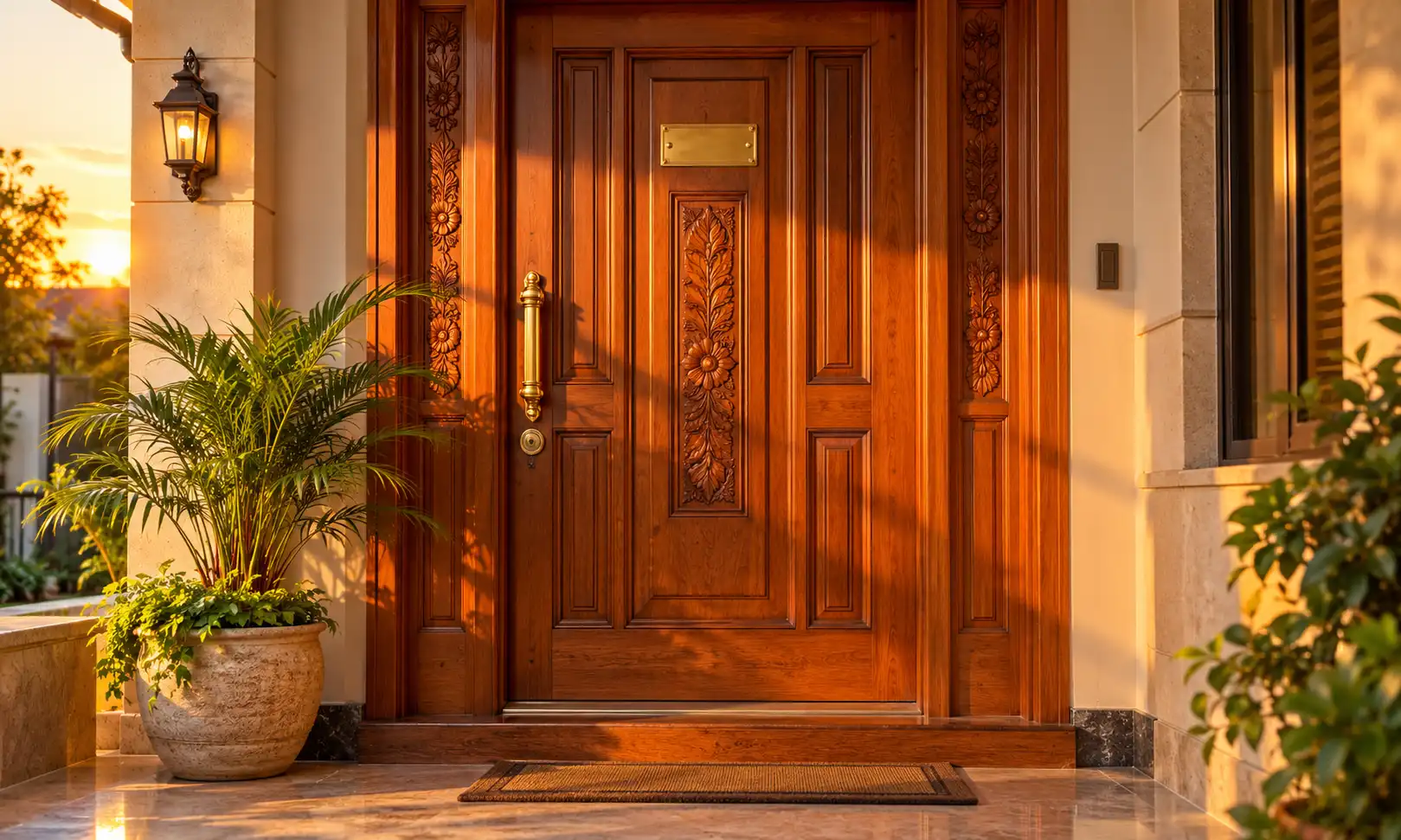
This is the section most guides cover in a single line. In the 32-pada scheme of the Vastu Purusha Mandala, each outer wall is divided into eight padas, and each pada is presided over by its own devata. The west facing house main door pada is counted along the west wall from the south-west corner towards the north-west.
| # | Pada name | Traditional result | Verdict |
|---|---|---|---|
| 1 | Pitru | Burdens tied to family and ancestral matters; a short-lived household | Avoid |
| 2 | Dauvarika | Effort that brings little reward, a sense of dissatisfaction | Avoid |
| 3 | Sugriva | Steady growth, gains in work and income | Best |
| 4 | Pushpadanta | Progress, wishes fulfilled, harmony with children | Best |
| 5 | Varuna | Comfort and abundance | Good |
| 6 | Asura | Friction, disputes, opposition | Avoid |
| 7 | Shosha | Steady drain of money and energy | Avoid |
| 8 | Papayakshma | Lingering health strain and recurring troubles | Avoid |
The pattern is easy to remember. The good zone is the third, fourth and fifth padas — slightly south of the middle of the wall. Both ends are difficult: the two padas nearest the south-west corner and the three nearest the north-west corner. In other words, the best west facing house main door pada is neither at a corner nor at the exact centre, but just below it.
Worked example — a 30-foot flat wall
Take a typical Noida 2BHK whose entrance wall faces west and measures 30 feet from its south-west corner to its north-west corner. Thirty divided by eight gives 3.75 feet per pada. Pitru runs from 0 to 3.75 feet, Dauvarika to 7.5, Sugriva to 11.25, Pushpadanta to 15, Varuna to 18.75, and the last three padas fill the remaining length up to the north-west corner. A three-foot door whose centre sits 12 feet from the south-west corner is on Pushpadanta — a good result. The same door with its centre at 21 feet is on Asura, and that is when the strengthening steps below become worth doing.
Two practical notes. Measure the outer face of the wall, not the inside of the room, and in a flat measure the wall of your own unit, not the building. And if a column or a duct breaks the wall, measure the full line from corner to corner anyway — padas follow the edge of the home, not the furniture against it.
How to check your own pada in five minutes
Measure the full west wall of the plot or the house, from the outer south-west corner to the outer north-west corner. Divide that length by eight. Starting at the south-west corner, count across until you reach the centre of your main door. That number is your pada. On a 40-foot wall each pada is five feet wide, so Sugriva runs from 10 to 15 feet and Pushpadanta from 15 to 20 feet, measured from the south-west corner. A door that spans two padas takes the result of whichever one holds its centre.
If your door sits at the north-west end
This is the most common problem we see in west facing homes, especially corner plots and builder floors, where the door is pushed towards the north-west so that a car can park alongside. It lands the entrance on Shosha or Papayakshma — the two padas the tradition is least comfortable with. The temptation is to assume the whole home is now a problem. It is not. The west facing house main door pada is one factor among five, and the others can still be right.
What we do in these cases is shift the weight of the entrance rather than the door. A wider, heavier door frame that extends towards Varuna, a raised threshold, a well-lit approach that leads the eye towards the south side of the door, and keeping the north-west corner just outside the door free of bins and parked two-wheelers. Where a renovation is already planned, moving the opening by even one pada is worth discussing with the architect.
Why Pada Numbers Differ from One Website to Another
If you have searched for this topic you will have seen contradictory advice: one site says the 3rd to 6th pada, another says the 5th and 6th, a third says “between west and south-west”. They are not all wrong. They are using two different systems and counting from different corners.
| System | Divisions | Counted from | Recommended zone |
|---|---|---|---|
| 32-pada mandala (used on this page) | 8 per wall, each named | South-west corner | 3rd to 5th — Sugriva, Pushpadanta, Varuna |
| Simplified nine-part grid (common online) | 9 equal parts, numbered only | Usually the north-west corner | 3rd to 6th, sometimes only 5th and 6th |
Lay both systems over the same wall and they agree on the important part: the target is the middle of the west wall, a little towards the south, and both corners are to be avoided. Where they differ is one narrow strip. The third segment of the nine-part grid, counted from the north-west, falls on what the 32-pada scheme calls Asura — a pada the classical tradition does not recommend. That is why we work with the named padas rather than a numbered grid: a name tells you which devata you are standing on, and a number only tells you how far you have walked.
So when you compare advice on the west facing house main door pada, ask two questions: how many divisions, and counted from which corner? Without those two answers a pada number on its own means very little.
West Facing House Plans — Zone Diagrams
Tables only take you so far. These three diagrams apply the same rules to real layouts: an independent 30 × 40 plot, a tower 2BHK, and the west wall divided into its eight padas. They are drawn to the zones described on this page rather than to a particular builder’s drawing, so you can lay your own plan beside them and compare. North is at the top in every diagram.
A 30 × 40 west facing plot: weight in the south and west — master bedroom, staircase and kitchen — with the pooja room, living area and study taking the light north and east. The entrance sits on Sugriva and Pushpadanta and opens into a foyer, not a bedroom.
The same logic inside a tower flat. You cannot move walls, but the stove corner, the master bedroom, a closed shoe cabinet and an uncluttered north-east are all yours to arrange.
The eight padas of the west wall at a glance. Green is favourable; red is traditionally avoided. The good zone sits just south of the middle of the wall.
Room Placement — The Nine-Zone Grid
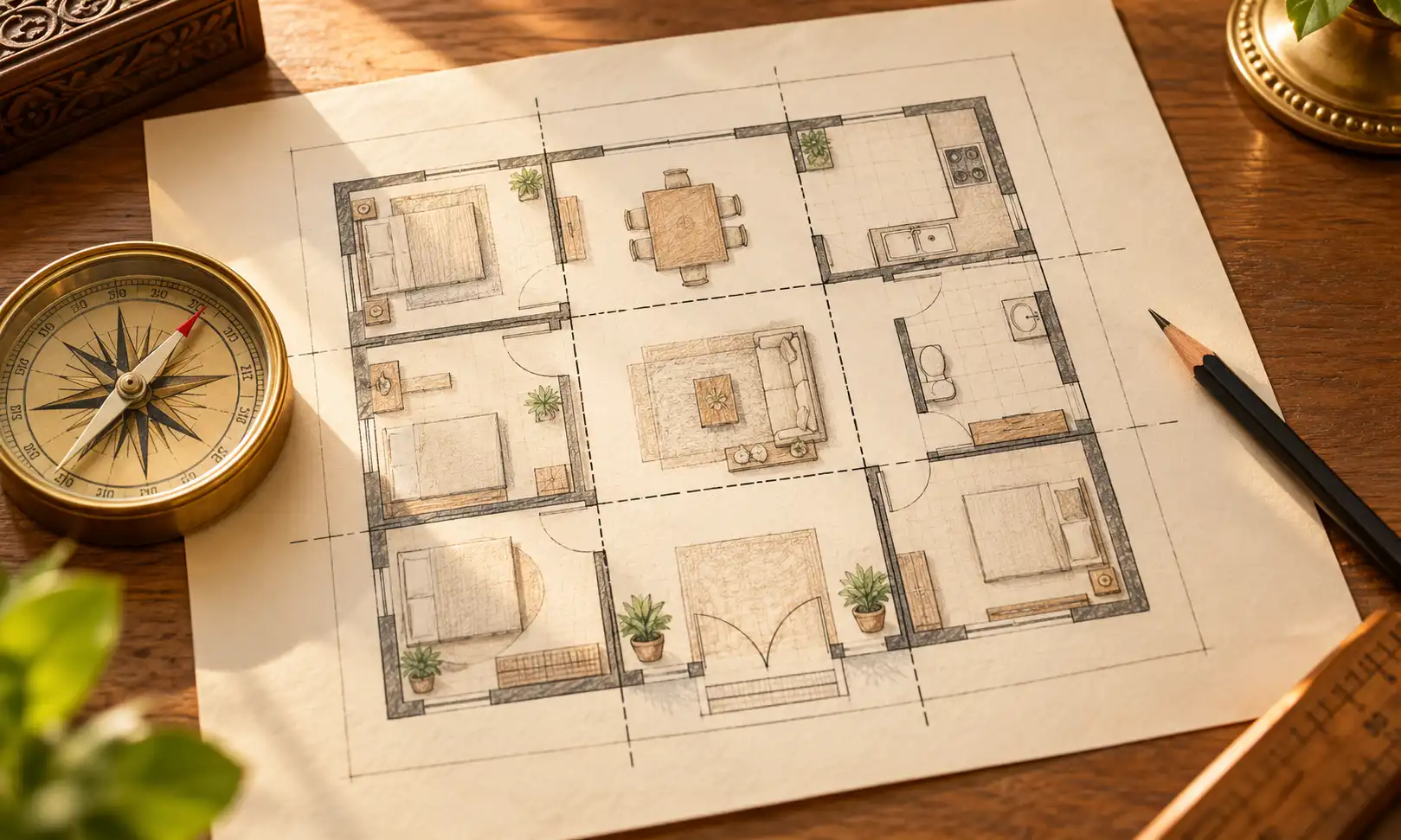
The planning logic of a west facing house is the same as every other orientation: weight in the south and west, lightness in the north and east. The difference is that the entrance and the most-used rooms tend to sit on the west side, so the west half has to carry both the weight and the daily traffic.
Two rules carry most of the weight. The master bedroom belongs in the south-west — and in a west facing house that room sits right beside the entrance side, so it should be entered from inside the home, never directly from the foyer. And the north-east must stay light: no toilet, no store, no staircase, no clutter. Get those two right and everything else is adjustment.
West Facing House Kitchen Direction
The kitchen is where west facing plans most often go wrong, because builders like to put it near the entrance to keep the plumbing short. The correct west facing house kitchen direction follows the same fire logic as any other home:
| Kitchen position | Verdict | Note |
|---|---|---|
| South-east | Best | The Agni corner; cook facing east |
| North-west | Good | The accepted second choice; stove in the south-east corner of the room, cook facing east |
| South | Workable | Keep the stove towards the south-east end |
| West | Workable | Common in builder plans; place the stove in the south-west of the kitchen with care, never facing the door |
| North-east | Avoid | Fire in the water zone is the classical mismatch |
| Centre | Avoid | Heat and weight in the brahmasthan |
Inside the kitchen, the stove matters more than the room. Wherever the kitchen sits, put the hob in the south-east part of the slab with the cook facing east, keep the sink away from the stove — ideally in the north-east part of the kitchen — and do not place the stove directly in line with the main door. If you can see the stove from the doorway, that is the one thing worth changing. Our full kitchen vastu guide covers the fridge, sink and shared-wall cases in detail.
West Facing House Staircase Direction
A staircase is heavy structure, and heavy structure belongs in the south and west half of a home. That suits a west facing house well, because the stairs can often sit near the entrance without breaking any rule. The correct west facing house staircase direction is:
| Position | Verdict | Note |
|---|---|---|
| South-west | Best | Adds weight exactly where it belongs |
| South or west | Good | The most practical choice in a west facing plan |
| North-west | Workable | Acceptable when nothing else is possible |
| North-east | Avoid | Blocks the zone the home depends on |
| Centre (brahmasthan) | Avoid | Weight in the centre is a classical defect |
Beyond position, the climb should turn clockwise — going up from north to south or from east to west — and classical practice prefers an odd number of steps. Storage or a powder room under the stairs is acceptable; a pooja space is not. In a duplex, avoid a staircase that lands directly in front of the main door, because the entrance should open into space, not into a flight of steps.
West Facing House Toilet Position
The safest west facing house toilet position is the north-west, with the west — between the entrance and the north-west corner — as the second choice. Two zones must be protected: the north-east, which is the light and water zone, and the south-west, which is the master bedroom and stability zone.
| Zone | Verdict | If it is already there |
|---|---|---|
| North-west | Best | — |
| West (north half) | Good | Keep the door away from the main entrance |
| South (with ventilation) | Workable | Keep dry, ventilate well |
| North-east | Avoid | Door shut, exhaust running, rock salt changed weekly, floor kept dry |
| South-west | Avoid | Do not store water or heavy items; keep scrupulously clean |
| Centre | Avoid | Keep in limited use, ventilate constantly |
One more point specific to west facing homes: because the entrance is on the west and the preferred toilet zone is also on the west, the two often end up side by side. That is acceptable, but the toilet door should never be visible from the main door, and it should never open into the entrance foyer. A short passage or a turned door solves it.
In a builder flat this is rarely your choice. Every remedy above is genuine traditional practice and costs almost nothing.
West Facing 2BHK Flat Vastu
In an independent house you plan; in a flat you inherit. With west facing 2bhk flat vastu the work shifts to the things you still control:
| What you control | What to do |
|---|---|
| Flat door | Check its pada along the west wall of your flat; keep the approach lit and clean |
| Stove | South-east corner of the kitchen, cook facing east |
| Master bedroom | The south-west room; head towards the south while sleeping |
| North-east corner | Keep it light — no shoe rack, dustbin or heavy storage |
| Heavy furniture | Along the south and west walls |
| West balcony | Shade it with plants or blinds; do not glass it in completely |
West facing towers are very common in Noida, Greater Noida and Noida Extension, because so many sectors are laid out on a north–south road grid. The pattern we see most often in these flats is the same three problems: a shoe rack or utility cabinet parked in the north-east, the master bedroom on the north side instead of the south-west, and a west-facing living room with a full-height glass wall that overheats every afternoon. The first two are fixed in a weekend. The third needs good curtains or external blinds — which is as much comfort as it is Vastu. See also our Vastu for flats and apartments guidance.
Pooja, Study and Bedroom — Three Rooms People Get Wrong
Pooja room. The north-east, with the person facing east or north while praying. In a west facing flat it is tempting to put the mandir near the entrance in the west, where there is often a convenient niche. Avoid that. If no north-east space exists, a clean shelf on an east or north wall, kept above waist height and never in a bedroom or against a bathroom wall, is the accepted compromise.
Study and work desk. The north, north-east or east, facing east or north while working. In a west facing home this usually means the study sits on the opposite side from the entrance, which is also the quieter side. The back should rest against a solid wall rather than a window.
Children’s bedroom. The west is traditionally good for children’s rooms, which works well in a west facing house. The north-west suits a guest room or a grown child who will move out — the north-west is associated with movement and change.
Colours, Materials and Light
Colour is the cheapest correction available, and in a west facing home it does double duty, because light colours on the west also reduce heat. The traditional colour for the west is white and soft grey, and its element is often linked to metal.
| Zone | Works well | Avoid |
|---|---|---|
| West | White, off-white, soft grey, light blue | Deep red, dark brown |
| South-west | Warm earth tones, beige, muted brown | Black, dark navy |
| North-east | White, light blue, pale yellow | Dark shades of any kind |
| North | Green, light blue | Red in large areas |
| Kitchen | Warm cream, soft orange, peach | Dark blue |
| Master bedroom | Earthy neutrals, muted rose | Stark white walls, bright red |
Material choices follow the same logic: heavier materials — stone, solid wood, brick — belong towards the south and west, while glass, mirrors and light partitions belong towards the north and east. Mirrors deserve a separate caution. A mirror on a west wall that faces the main door is one of the most common mistakes in west facing flats; mirrors belong on north or east walls and should never directly face the entrance or the bed.
A Ten-Minute Site Walk Before You Decide
If you are viewing a west facing property this week, check things in this order. It takes about ten minutes and tells you more than any article can:
| Step | What to do | What it tells you |
|---|---|---|
| 1 | Stand inside the door, facing out, and take a compass reading | Confirms the real orientation — many “west facing” listings are north-west or south-west |
| 2 | Measure the west wall and locate the door along it | Gives you the entrance pada |
| 3 | Look at how the ground falls towards the road | Reveals the slope — the factor that is hardest to change |
| 4 | Find the north-east corner and see what occupies it | Toilet, store or staircase here is the most serious internal defect |
| 5 | Check where the kitchen and master bedroom sit | Both are correctable, but you should know before you negotiate |
| 6 | Visit once between 3 and 5 pm | Shows you how much afternoon sun the west rooms really take |
| 7 | Photograph every room with the compass visible | Lets a consultant review the property properly afterwards |
West, North-West or South-West? Most Listings Get This Wrong
Before any rule on this page applies, the orientation has to be right — and a large share of properties advertised as west facing are genuinely something else. Agents often describe the road, not the door, and families repeat what they were told when they bought.
| Compass reading at the door | Actual orientation | What changes |
|---|---|---|
| 247° to 292° | True west | Everything on this page applies directly |
| 292° to 337° | North-west | The zone of air and movement — generally workable, with its own entrance rules |
| 202° to 247° | South-west | The one entrance placement classical texts genuinely caution against |
The third row is the one that matters. A true west entrance on a good pada is a sound home. A south-west entrance needs real attention, because it opens the zone meant to stay closed and heavy. If your compass reads below about 247 degrees, treat the property as south-west and have the entrance assessed before you commit.
Independent House, Builder Floor and Tower Flat — What Applies to You
| Property type | What you control | Where to focus |
|---|---|---|
| Independent house or villa | Plot, slope, entrance, every internal zone | Slope and entrance pada first, at the planning stage |
| Builder floor | Internal layout, sometimes the flat entrance | North-east, master bedroom and stove placement |
| Tower flat | Internal arrangement only | Sleeping direction, stove corner, clearing the north-east, shading the west |
| Rented home | Furniture and habits | Bed direction, entrance upkeep, clutter — all at zero cost |
Tower flat buyers worry the most and need to the least. In a high-rise the plot slope is not yours and the building entrance is not yours. What reaches your own four walls is a short list of variables, and nearly all of them can be adjusted by moving furniture rather than masonry.
What Vastu Can and Cannot Do — An Honest Note
Every guide on this subject should carry this section, and few do. Vastu is a traditional system of spatial planning. Much of it lines up with good climate design — light, ventilation, drainage, shade — and much of it is a tradition people find meaningful in their homes. It is not a laboratory science, and nobody can honestly promise you a specific outcome from moving a door or a bed.
What a well-planned home reliably gives you is practical: rooms that are easier to use, an entrance that does not feel cramped, a bedroom that stays cool and quiet, a kitchen that works. Those are real, and they are reason enough. Be careful of anyone who ties a correction to a promised result on a promised timeline, or who insists that a home is unliveable unless walls come down. Almost every correction in a west facing home can be done with furniture, colour, light and order.
And if you already live in a west facing home that has served your family well, that is evidence too. The direction itself was never the problem.
Key Takeaways
- ● No direction is inauspicious in the classical texts — the pada of the door matters more than the direction.
- ● On the west wall the good padas are Sugriva, Pushpadanta and Varuna — the 3rd to 5th from the south-west corner.
- ● West facing plots often slope towards the road; check the slope before you buy.
- ● Master bedroom south-west, stove south-east, staircase south or west, toilet north-west.
- ● Shade the west wall — it is both the Vastu rule and the comfort rule.
- ● Almost every internal correction is possible without demolition.
Common Mistakes — and the Fix
15-Point West Facing House Checklist
- Main door pada identified and recorded
- Door on Sugriva, Pushpadanta or Varuna
- Entrance well lit after sunset and clutter-free
- Raised threshold at the main door
- Canopy or shade over the west entrance
- Plot higher in the south-west than the north-east
- North-east open, light and dry
- No toilet or store in the north-east
- Master bedroom in the south-west
- Head points south while sleeping
- Stove in the south-east, cook faces east
- Staircase in the south, west or south-west
- Toilet in the north-west or west, not visible from the door
- Centre of the home kept open
- West wall shaded; heavy furniture on south and west walls
Read Next in This Series
Frequently Asked Questions
Which is the best west facing house main door pada?
Is west facing house good or bad as per Vastu?
What is the right west facing house kitchen direction?
What is the correct west facing house staircase direction?
Where should the toilet be in a west facing house?
How does west facing 2bhk flat vastu work?
Why do some websites say the 3rd to 6th pada from the north-west?
Dr. Kkomal Vasisht has completed 15,000+ consultations over 15+ years — 5.0★ from 159 Google reviews. At our Greater Noida office, on site across Noida and Delhi NCR, or online from a floor plan.
Book a Vastu ConsultationAsk on WhatsApp