
South Facing House Main Door Pada — The Complete Vastu Guide
Which pada your door stands on decides more than the direction itself. Here is the full pada table, the honest answer on whether a south facing house is good or bad, and every fix that needs no demolition.
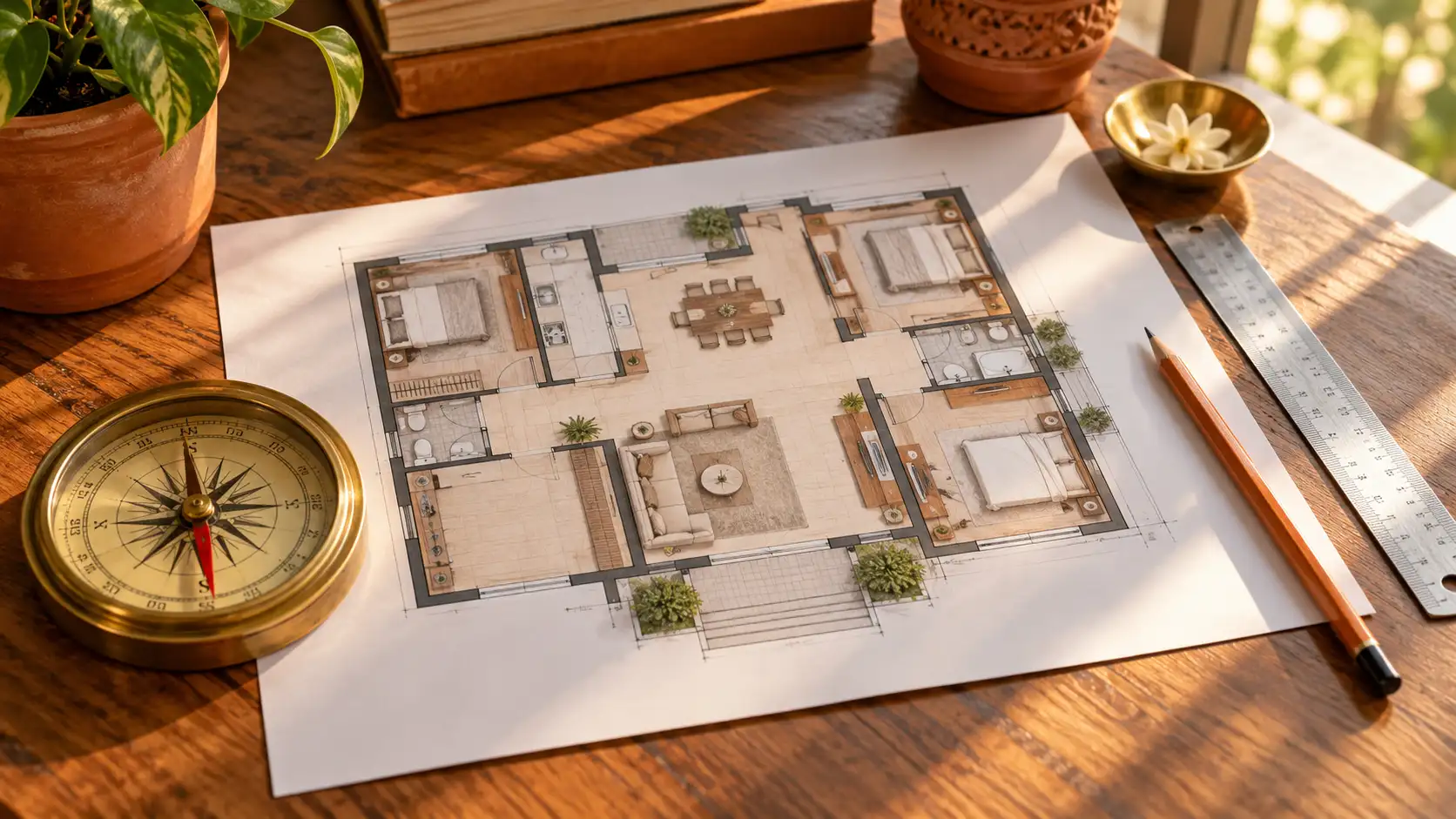
Is South Facing House Good or Bad? The Honest Answer
Ask ten people and nine will tell you to avoid it. Ask the classical texts and you get a very different answer. So — is south facing house good or bad? Neither, by default. No Vastu text calls the south inauspicious. The south is ruled by Yama, who in the tradition is the keeper of discipline and order, not a bringer of misfortune. The texts also place Lanka, the golden city of wealth, firmly in the south.
The question is south facing house good or bad is really four questions, and this is the order an experienced consultant checks them in:
| What decides it | Good when | Problem when |
|---|---|---|
| Main door pada | Gruhakshat, Gandharva or Bhringaraj | Anila, Vitatha or Yama |
| Plot slope | Higher in the south and west, lower in the north and north-east | Higher in the north-east |
| North-east zone | Open, light, uncluttered | Toilet, store, staircase or heavy clutter |
| Kitchen | South-east, or stove in the south-east of the kitchen | North-east |
| Master bedroom | South-west | North-east |
Four of these five are fixable without touching a wall. That is why the honest answer is: it depends almost entirely on details you can inspect in twenty minutes — and mostly correct afterwards.
The practical advantages nobody mentions
- Strong afternoon light, which keeps rooms dry through the monsoon.
- Warmer through north-Indian winters — a real comfort advantage in Delhi NCR.
- South facing plots are often priced lower, so the same budget buys more space.
- The south-west, the zone of stability, is naturally strong in these homes.
Why the South Carries a Bad Name
The reputation has a traceable origin. In the Vastu Purusha Mandala the body of the Vastu Purusha lies face down with the head in the north-east and the feet in the south-west. The south-west therefore carries weight, and weight became associated with heaviness, and heaviness with difficulty. Add to that the position of Yama as the dikpal of the south, and a folk belief formed: the south is the direction of endings.
The classical texts never drew that conclusion. Yama in the tradition is the keeper of time and order — the principle that gives structure to a life, not the one that shortens it. The same south direction is where the texts place Lanka, described as a city of gold. A direction cannot be both the source of ruin and the seat of unimaginable wealth. What the texts actually say is narrower and more useful: the south must be kept heavy, closed and protected, while the north and east stay light and open. A house that respects that rule is sound whichever way its door opens.
There is also a practical layer. In most of India the south wall takes the harshest sun. Before cavity walls, insulation and cross-ventilation, a thin south wall made a house genuinely uncomfortable, and builders learned to keep the south thick, shaded and solid. That is engineering wisdom encoded as tradition, and modern construction has already solved most of it.
The Slope Rule — the One Thing You Cannot Fix Later
Of everything on this page, plot slope is the one factor worth checking before you buy rather than after. The ground should be higher in the south and west, falling gently towards the north and north-east. Water should drain towards the north-east, never collect in the south-west.
This matters more than the entrance, because an entrance can be strengthened and a slope usually cannot — not without earthworks that cost more than the correction is worth. When a plot slopes the wrong way, the traditional remedy is to raise the south-west with filled earth or a heavier structure on that side, and the time to do that is at the planning stage.
A simple test for a built property: after rain, see where water stands. If it pools near the south-west corner, that is the defect to address first. In an apartment the slope question does not apply to you individually, which is one reason flat buyers can be far more relaxed about orientation than plot buyers.
Reading the Entrance Zone, Not Just the Door
The door is one element in an entrance zone that extends a few feet in every direction, and the zone is judged as a whole:
| Element | What to look for | Why it matters |
|---|---|---|
| Approach path | Clear, even, well lit | Obstruction at the approach affects the whole zone |
| Threshold | Raised, in wood or stone | Classically marks the boundary of the home |
| Door weight | Solid, opening inwards and clockwise | A light hollow door is considered weak for a main entrance |
| Facing structure | No pole, transformer or sharp corner directly opposite | These are the classic shoolas, or piercing defects |
| Shoe storage | Outside or enclosed, never loose inside the doorway | Clutter at the entrance is the single most common defect we see |
| Lighting | Warm, always working | A dark entrance undoes an otherwise good placement |
We have walked into homes with a textbook-perfect entrance placement where the practical experience was poor, simply because the approach was dark and the doorway was stacked with footwear. We have also seen homes on a difficult pada that felt settled and orderly, because every one of the points above had been handled. Placement sets the ceiling; upkeep decides how close you get to it.
South Facing House Main Door Pada — The Full Table
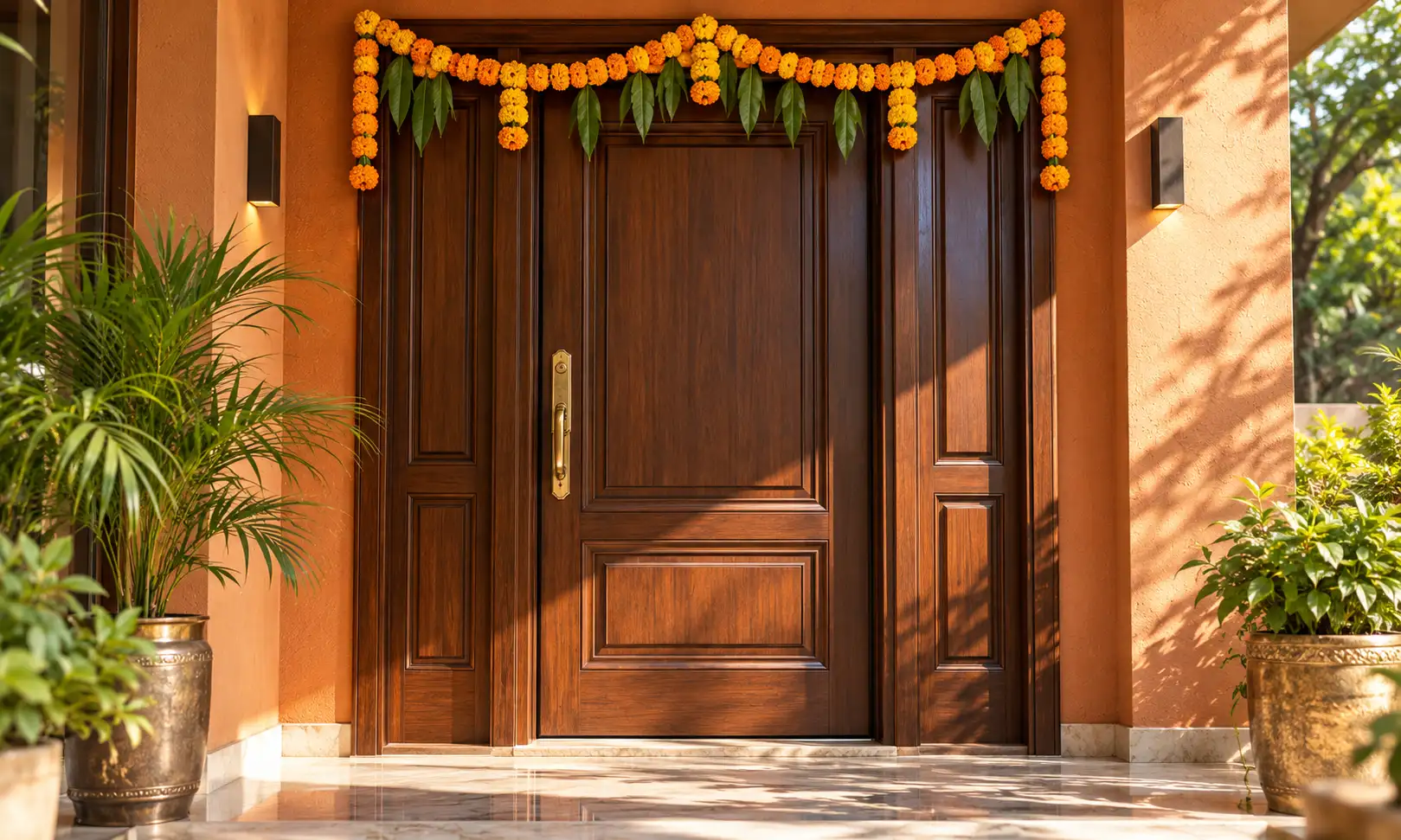
This is the section most guides skip with one line about "the south-east quadrant". The south wall is divided into eight padas, counted from the south-east corner towards the south-west. Each carries its own name and result, and the south facing house main door pada is what genuinely decides the outcome of the orientation.
| # | Pada name | Traditional result | Verdict |
|---|---|---|---|
| 1 | Anila (Vayu) | Restlessness, instability, scattered effort | Avoid |
| 2 | Pusha | Nourishment, but traditionally mixed for an entrance | With care |
| 3 | Vitatha | Falsehood, wasted effort, broken promises | Avoid |
| 4 | Gruhakshat | Stability of the home, steady prosperity | Best |
| 5 | Yama | Discipline turning to pressure, health strain | Avoid |
| 6 | Gandharva | Charm, recognition, social standing | Good |
| 7 | Bhringaraj | Gains through effort, resourcefulness | Good |
| 8 | Mriga | Restlessness, frequent movement | With care |
How to check your own pada in five minutes
Measure the full south wall. Divide the length by eight. Starting at the south-east corner, count across until you reach the centre of your main door — that number is your south facing house main door pada. A door spanning two padas takes the result of whichever one holds its centre.
South Facing House Good for Which Rashi?
People often ask whether a south facing house good for which rashi question even has an answer. Traditionally it does, though it is a preference rather than a rule — the pada matters far more than the rashi.
The useful answer is this: a Mars or Saturn strong chart settles into a south facing home quickly, but no chart is barred from one. We have never advised a client to reject a property on rashi grounds alone.
South Facing House Plans — Zone Diagrams
Numbers and tables take you only so far. These three diagrams show the same rules applied to real layouts: an independent 30 × 40 plot, a tower 2BHK, and the south wall divided into its eight padas. Each one is drawn to the zones described above, not to a specific builder’s drawing, so you can lay your own plan beside it and compare.
A 30 × 40 south facing plot: weight in the south and west — master bedroom and kitchen — with the pooja room, living area and study taking the light north and east. The entrance sits on the Gruhakshat pada.
The same logic inside a tower flat. You cannot move walls, but the stove corner, the master bedroom, the entry foyer and an uncluttered north-east are all yours to arrange.
The eight padas of the south wall at a glance. Green is favourable, amber needs care, red is traditionally avoided.
Room Placement — The Nine-Zone Grid
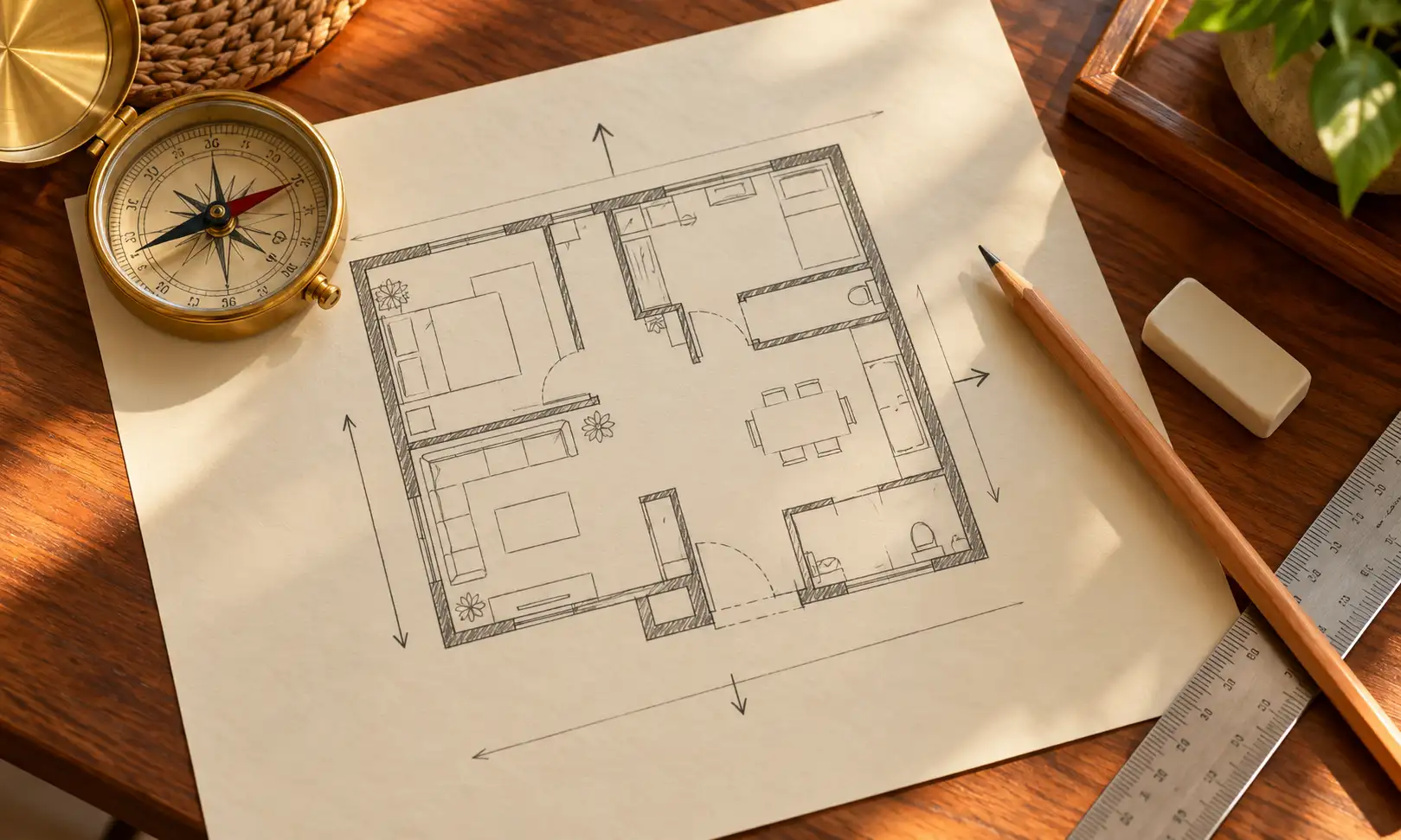
In a south facing house the planning logic is simple: keep weight in the south and west, keep the north and east light and open.
Two rules carry most of the weight here. The master bedroom belongs in the south-west, which is naturally strong in a south facing house. And the north-east must stay light — no toilet, no store, no staircase, no clutter. Get those two right and the rest is adjustment.
South Facing House Staircase Direction
A staircase is heavy structure, and heavy structure belongs in the south and west half of a home. The correct south facing house staircase direction is therefore:
| Position | Verdict | Note |
|---|---|---|
| South-west | Best | Adds weight exactly where it belongs |
| South or west | Good | Standard in most south facing plans |
| North-west | Workable | Acceptable when nothing else is possible |
| North-east | Avoid | Blocks the zone the home depends on |
| Centre (brahmasthan) | Avoid | Weight in the centre is a classical defect |
Beyond position, the direction of climb should be clockwise — north to south or east to west — with an odd number of steps in classical practice. Storage or a washroom under the stairs is acceptable; a pooja space is not.
South Facing House Toilet Position
The safest south facing house toilet position is the north-west, with west as the second choice. Two zones must be protected: the north-east, which is the light zone, and the south-west, which is the master bedroom and stability zone.
| Zone | Verdict | If it is already there |
|---|---|---|
| North-west | Best | — |
| West | Good | — |
| South (with ventilation) | Workable | Keep dry, ventilate well |
| North-east | Avoid | Door shut, exhaust running, rock salt changed weekly, floor dry |
| South-west | Avoid | Avoid storing water or heavy items; keep scrupulously clean |
| Centre | Avoid | Keep unused where possible, ventilate constantly |
In a builder flat this is rarely your choice. Every remedy above is genuine traditional practice and costs almost nothing — which is exactly how it should be.
South Facing 2BHK Flat Vastu
In an independent house you plan. In south facing 2bhk flat vastu you inherit, so the work shifts to what you still control:
| What you control | What to do |
|---|---|
| Flat door | Check its pada along the south wall of your flat; keep the approach lit and clean |
| Stove | South-east corner of the kitchen, cook facing east |
| Master bedroom | The south-west room; head towards the south while sleeping |
| North-east corner | Keep it light — no shoe rack, dustbin or heavy storage |
| Heavy furniture | Along the south and west walls |
| Balcony | Use a north or east balcony; do not seal it off |
Most flat problems we see in Greater Noida and Noida towers come down to three things: a cluttered north-east, the master bedroom in the north-east instead of the south-west, and the stove on the wrong side of the kitchen. All three are fixable in a weekend. See also our Vastu for flats and apartments guidance.
Kitchen, Pooja and Study — the Three Rooms People Get Wrong
Kitchen. The south-east is the fire corner and the first choice. Where the kitchen sits elsewhere, the stove should still occupy the south-east corner of whichever room it is in, with the cook facing east. The north-east is the placement to avoid: fire in the water zone is the classical mismatch, and it is also the hardest to live with day to day. Our kitchen guide covers the stove, sink and fridge positions in full.
Pooja room. The north-east, with the person facing east or north while praying. In an apartment where no north-east corner is available, a clean shelf on a north or east wall, kept above waist height and never in a bedroom or against a bathroom wall, is the accepted compromise.
Study and work desk. The north-east, east or north, facing east or north while working. In a home office the back should rest against a solid wall rather than a window — the traditional rule and the modern ergonomic one agree here, and the difference in how a long working day feels is immediate.
Colours, Materials and Light
Colour is the cheapest correction available and the one most often misapplied. In a home with the entrance on the south wall:
| Zone | Works well | Avoid |
|---|---|---|
| South-west | Warm earth tones, terracotta, muted brown | Black, charcoal, dark navy |
| South | Terracotta, warm red accents, cream | Heavy dark grey |
| North-east | White, light blue, pale yellow | Dark shades of any kind |
| North | Green, light blue | Red in large areas |
| Kitchen (south-east) | Warm cream, soft orange, peach | Dark blue |
| Master bedroom | Earthy neutrals, muted rose | Bright red or stark white walls |
Material choices follow the same logic: heavier materials — stone, solid wood, brick — belong towards the south and west, while glass, mirrors and light partitions belong towards the north and east. Mirrors deserve a separate caution. They are often recommended as a universal remedy, but a mirror on a south or south-west wall reflects weight back into a zone that is meant to hold it. Mirrors belong on north or east walls, and never directly facing the main door or the bed.
A Ten-Minute Site Walk Before You Decide
If you are viewing a property this week, this is the order worth checking things in. It takes about ten minutes and tells you more than a long article can:
| Step | What to do | What it tells you |
|---|---|---|
| 1 | Stand outside, facing the main door, and take a compass reading | Confirms the actual orientation — many "south facing" listings are south-west or south-east |
| 2 | Measure the front wall and locate the door’s position along it | Gives you the entrance pada |
| 3 | Look at the ground level across the plot | Reveals the slope — the factor you cannot easily change |
| 4 | Find the north-east corner and see what occupies it | Toilet, store or staircase here is the most serious internal defect |
| 5 | Check where the kitchen and master bedroom sit | Both are correctable, but you should know before negotiating |
| 6 | Note anything directly opposite the entrance | Poles, transformers and sharp corners are classical obstructions |
| 7 | Photograph every room with the compass visible | Lets a consultant review the property properly afterwards |
Buyers who do this routinely report the same thing: the compass reading alone rules out a surprising number of properties described as one orientation when they are genuinely another.
What a Consultation Actually Involves
Three questions come up often enough to answer plainly.
Does a correction require breaking walls? Almost never. In fifteen years of practice the vast majority of corrections have involved moving a stove, relocating a bed, clearing a corner, changing a colour or adding a threshold. Demolition is a last resort and usually a sign that someone is selling rather than advising — see our non-demolition approach.
How soon does anything change? Honestly: the physical corrections happen in days, and what people notice first is usually practical — a room that is easier to use, an entrance that no longer feels cramped, sleep that settles. Anyone promising specific outcomes on a specific timeline is overstating what this subject can do.
Is it worth it for a rented flat? For a rental the sensible scope is small: the sleeping direction, the stove position if the kitchen allows it, and keeping the north-east clear. Those three cost nothing and travel with you to the next home.
Key Takeaways
- ● No direction is inauspicious in the classical texts — the entrance position within the wall is what matters.
- ● Check the slope before you buy; it is the one factor that is expensive to correct afterwards.
- ● Keep the north-east light and open, and the south-west heavy and solid.
- ● Master bedroom south-west, stove south-east, staircase south or west.
- ● Almost every internal correction is possible without demolition.
- ● Upkeep — light, cleanliness, order — decides how much of the placement you actually get.
Common Mistakes — and the Fix
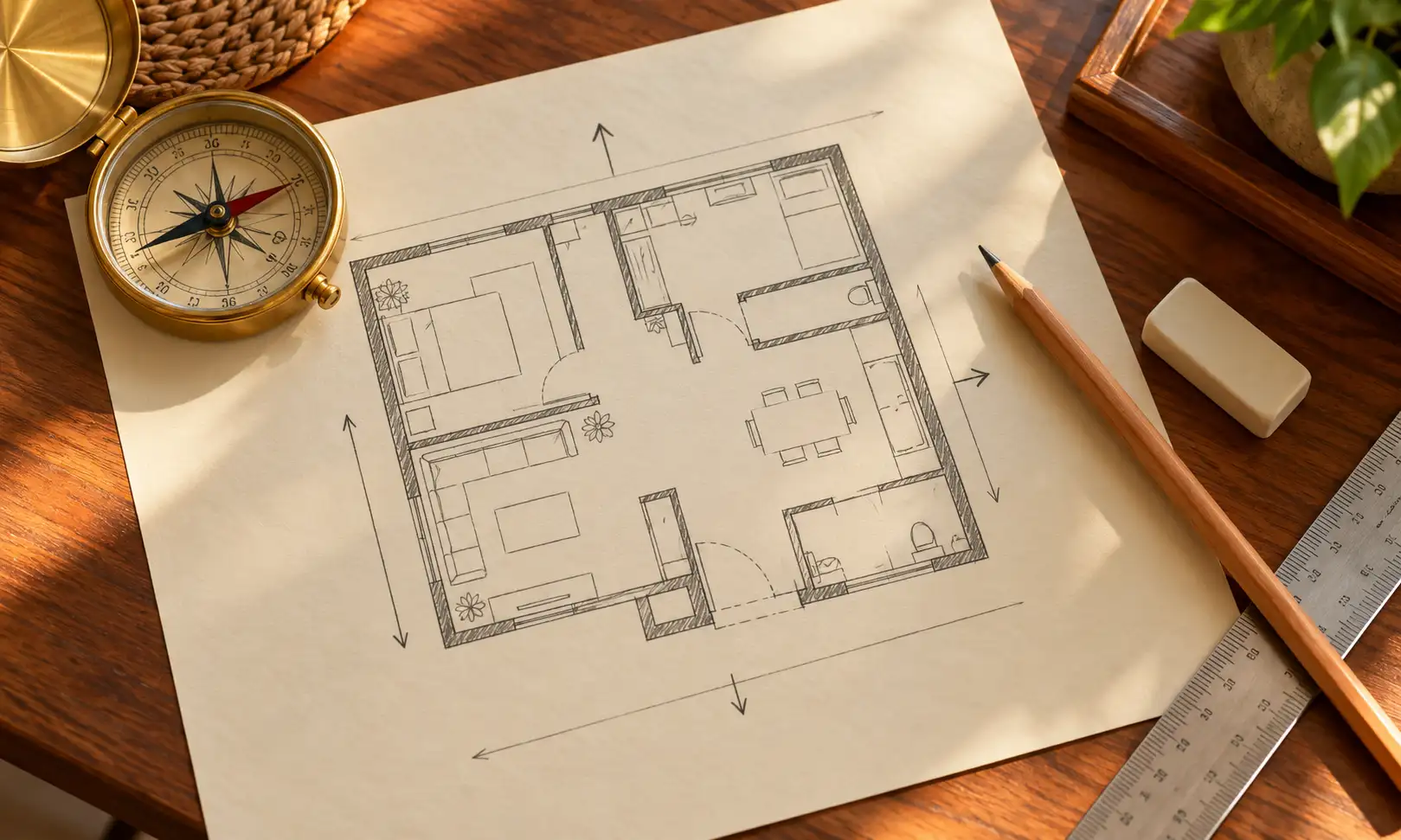
South, South-East or South-West? Most Listings Get This Wrong
Before any of the rules on this page apply, the orientation has to be correct — and in our experience a large share of properties advertised one way are genuinely another. Agents often describe the road position rather than the door position, and families repeat what they were told at the time of purchase.
| Compass reading at the door | Actual orientation | What changes |
|---|---|---|
| 157° to 202° | True south | Everything on this page applies directly |
| 112° to 157° | South-east | Fire zone at the entrance — different rules, generally easier |
| 202° to 247° | South-west | The one placement classical texts genuinely caution against |
The distinction matters most for the third row. A true south entrance on a good pada is workable. A south-west entrance is the placement that needs real attention, because it sits on the zone meant to stay closed and heavy. If your compass reads past 202 degrees, treat the property as south-west and have the entrance assessed properly before committing.
Independent House, Builder Floor and Tower Flat — What Applies to You
| Property type | What you control | Where to focus |
|---|---|---|
| Independent house or villa | Plot, slope, entrance, every internal zone | Slope and entrance first, at the planning stage |
| Builder floor | Internal layout, sometimes the flat entrance | North-east, bedroom and stove placement |
| Tower flat | Internal arrangement only | Sleeping direction, stove corner, clearing the north-east |
| Rented home | Furniture and habits | Bed direction, entrance upkeep, clutter — all zero cost |
Buyers of tower flats worry the most and need to the least. In a high-rise the plot slope is not yours, the common entrance is not yours, and what reaches your own four walls is a smaller set of variables — nearly all of which can be adjusted by moving furniture rather than masonry.
Before and After — What a Correction Looks Like in Practice
A typical three-bedroom home in Greater Noida, assessed and corrected without any construction work:
Total cost: a tin of paint, a plumber for half a day and a weekend of rearranging. No wall was touched. That is what a realistic correction looks like, and it is the standard we hold ourselves to on every site visit.
15-Point South Facing House Checklist
- Main door pada identified and recorded
- Entrance well lit and clutter-free
- Raised threshold at the main door
- North-east open, light and dry
- No toilet or store in the north-east
- Master bedroom in the south-west
- Head points south while sleeping
- Stove in the south-east, cook faces east
- Sink away from the stove
- Staircase in the south, west or south-west
- Centre of the home kept open
- Heavy furniture along south and west walls
- Water sources in the north or north-east
- Warm earth tones in the south-west
- Plot higher in the south-west than the north-east
Read Next in This Series
Frequently Asked Questions
Which is the best south facing house main door pada?
Is south facing house good or bad as per Vastu?
What is the right south facing house staircase direction?
Where should the toilet be in a south facing house?
What changes in a south facing 2bhk flat?
Is a south facing house good for which rashi?
Dr. Kkomal Vasisht has completed 15,000+ consultations over 15+ years — 5.0★ from 159 Google reviews. At our Greater Noida office, on site across Noida and Delhi NCR, or online from a floor plan.
Book a Vastu ConsultationAsk on WhatsApp