
Commercial Vastu Consultant in Greater Noida for Offices, Shops & Factories
Looking for an experienced commercial Vastu consultant in Greater Noida? BhagyaVastu, led by Dr. Kkomal Vasisht, delivers structured, audit-based Vastu consultation for offices, showrooms, shops, restaurants and industrial units across Delhi NCR — with practical, no-demolition remedies that respect your business continuity.

What this guide covers
- Signs your space needs an audit
- What commercial Vastu actually is
- The eight-direction energy map
- Main entrance principles
- Office Vastu, zone by zone
- Shop & showroom Vastu
- Factory & warehouse Vastu
- Guidance by business type
- Cash flow & wealth zones
- Common dosh & remedies
- Serving Greater Noida & Delhi NCR
- Our audit process
- Consultation fees
- Frequently asked questions
Every business owner has met the same frustrating pattern at least once. The product is sound. The team works hard. The pricing is competitive. And still, something does not move. Payments arrive late. Good staff leave without a clear reason. A shop sees healthy footfall but weak billing. A factory runs into one small breakdown after another. When the visible factors are all in order and results still lag, it is worth examining the one factor most businesses never audit at all — the space itself.
Commercial Vastu is the applied study of how a workspace's orientation, layout and internal zoning influence the people and activity inside it. It is not superstition, and it is not a substitute for strategy. It is an environmental discipline: place the right function in the right zone, remove the friction points, and the space starts supporting the work instead of quietly obstructing it. That is the entire premise, and it is why a structured audit often surfaces issues an owner has lived with for years without ever naming them.
At BhagyaVastu we have carried out this work across more than 500 commercial spaces over 15+ years — offices and co-working floors, retail shops and showrooms, restaurants, clinics, schools, warehouses and manufacturing units. What follows is a detailed, practical guide to how commercial Vastu works, what we examine during an audit, and what corrections typically look like in practice. Read it in full and you will understand the subject considerably better than most generic advice online allows.
Signs Your Commercial Space May Need a Vastu Audit
A commercial Vastu audit is worth considering when business problems repeat in a pattern that ordinary management fixes do not resolve — persistent cash-flow tightness, repeated staff attrition, strong footfall with weak conversion, or recurring breakdowns concentrated in one part of the premises.
No single symptom proves a Vastu issue. What matters is the pattern: problems that recur in the same form, resist the obvious commercial fixes, and often cluster in a particular area of the premises. If several of the following feel familiar, an audit is likely to be informative.
- Cash flow stays tight even in months when sales and market conditions are good
- Reliable staff keep resigning, or the team feels persistently low-energy and unfocused
- Footfall without conversion — customers browse the shop, then leave without buying
- Payments from dependable clients are delayed again and again without explanation
- Equipment faults or minor accidents repeat in one specific corner of the premises
- Decisions stall in meetings; partnerships turn sour without an obvious cause
- Expansion plans get blocked at the last step, despite funding and planning being in place
- The premises feel heavy or tiring — staff and visitors mention it without being asked
- Disputes or compliance trouble appear unusually often for your sector
Before you book anything — check your space yourself
You can get an initial read on your premises at no cost. The free direction finder tool helps you establish your building's true facing direction, which is the starting point of every commercial Vastu assessment. It takes about a minute.
What Is Commercial Vastu — and Why Home Vastu Advice Fails in a Business
Commercial Vastu is the specialised application of Vastu Shastra to business premises, tuned for productivity, cash flow, client relationships and organisational stability — unlike residential Vastu, which is oriented towards rest, health and family harmony.
The distinction matters more than most people expect. A home is designed to help its occupants settle, recover and feel secure. A business premises has an almost opposite requirement: it needs outward momentum, competitive energy, decisiveness and transactional flow. Applying residential principles to a commercial space is one of the most common mistakes we encounter — and it is an easy one to make, because the overwhelming majority of Vastu content available online is written for homes.
Commercial Vastu also varies sharply by business function. A retail store depends on attraction and transaction energy. A factory depends on uninterrupted directional flow. A professional office depends on clear decision zones and stable authority placement. A restaurant has to balance a strong fire element in the kitchen against a calm, welcoming dining area. These are genuinely different energetic requirements, and a competent audit begins by identifying which one applies to you.
The most common and costly mistake
Copying home Vastu tips into an office or shop. The arrangements that create calm and rest at home can dampen exactly the expansion-oriented, competitive energy a business needs to grow. Commercial premises must be assessed by business function, never treated as a large home.
It is equally important to be clear about what Vastu does not claim. It optimises the environment in which your work happens. It does not replace product quality, pricing strategy, marketing or management competence. Any consultant who promises guaranteed revenue figures from a Vastu correction is overstating the discipline. Our position has always been straightforward: Vastu removes environmental friction so that your existing effort converts more efficiently. For the wider strategic view of these principles, our guide on Vastu for business growth covers that ground in more depth.
The Eight-Direction Energy Map for Commercial Spaces
In Vastu Shastra each of the eight directions governs specific business functions — North for cash flow, East for innovation, South-West for leadership stability, South-East for energy and production. Placing the right activity in the matching zone is the foundation of a well-aligned commercial premises.
Every commercial Vastu audit begins with this map. We overlay a directional grid on your floor plan, identify which activity currently occupies each zone, and compare it against what that zone naturally supports. Most correction lists come directly out of the mismatches this exercise exposes.
| Direction | Element / Governs | Best Used For | Typical Issues When Misaligned |
|---|---|---|---|
| North | Water · cash flow, opportunities | Entrance, reception, client-facing areas, cash handling | Stagnant growth, opportunities that do not convert |
| East | Air · innovation, visibility | Sales, marketing, product development, new initiatives | Weak marketing traction, stale product thinking |
| West | Space · systems, gains | Accounts, HR, back-office, records, storage | Process failures, internal friction, admin errors |
| South | Earth · reputation, authority | Senior management, heavy machinery, archives | Reputation problems, leadership instability |
| North-East | Water · clarity, planning | Boardroom, strategy, partnerships, quiet space | Poor decisions, partnerships that fail repeatedly |
| South-East | Fire · energy, action | Pantry, kitchen, production, electricals, servers | Low drive, production delays, recurring disputes |
| South-West | Earth · strength, foundation | Owner or director cabin, heavy equipment, safe | Weak footing, lack of support, instability at the top |
| North-West | Air · movement, networking | Sales floor, guest relations, dispatch, finished goods | Poor communication, slow movement, stalled deliveries |
Two zones deserve special mention because they are the ones most frequently damaged in commercial fit-outs. The North-East should be kept light, clean and relatively open — it is the zone of clarity, and burying it under storage, a toilet or heavy machinery tends to correlate with muddled decision-making. The Brahmasthan, the central area of the premises, should stay uncluttered and ideally free of heavy fixed structures; it functions as the circulatory centre of the space. You can check your own layout against this principle using the free Brahmasthan checker.
The Main Entrance: Your Business's Mouth of Energy
In commercial Vastu the main entrance is the primary channel through which clients, opportunities and revenue enter a business. Its direction, proportion, approach path and immediate internal view are assessed in every audit, because a problematic entrance creates friction regardless of how good the business is.
Classical texts describe the entrance as the mukh, or mouth, of a structure. In a commercial context the metaphor is unusually literal: it is the point at which external opportunity physically enters your premises. When we audit an entrance we examine six things in sequence.
What we assess at the entrance
- Direction — North, East and North-East entrances generally support growth and incoming opportunity for most business types
- Proportion — the main entrance should be the largest opening in the premises; a grand side entrance with a small main door dilutes the entry channel
- Approach path — the space directly in front should be clear and unobstructed, with no pillar, pole, transformer or tree directly facing the door
- Immediate internal view — what a visitor sees on entering sets the tone; a toilet door, a staircase descending towards the entrance, or a blank dead wall are all corrected
- Threshold condition — an unbroken, clean, well-maintained threshold with a defined step or marker; cracked tiles and loose fittings here are always flagged
- Lighting and signage — a well-lit, clearly identified entrance with functioning lights; dead bulbs at the entrance are among the simplest and most frequently ignored corrections
Check your entrance for free
Run a preliminary entrance assessment yourself with the free entrance check tool. It gives you a quick directional reading before you decide on a full professional audit.
One clarification is worth making, because it causes unnecessary anxiety: a South or West facing entrance is not automatically bad. Certain business types perform well with those orientations, and in many cases the entrance direction can be balanced through placement and elemental corrections rather than relocation. Direction is one input among many, not a verdict on the premises.
Office Vastu: From the Owner's Cabin to the Pantry
Office Vastu allocates each department to the zone that supports its function — accounts in the West, sales in the East, senior management in the South-West — and positions employees to face North or East wherever possible. Misplaced departments create persistent internal friction that no reorganisation resolves.
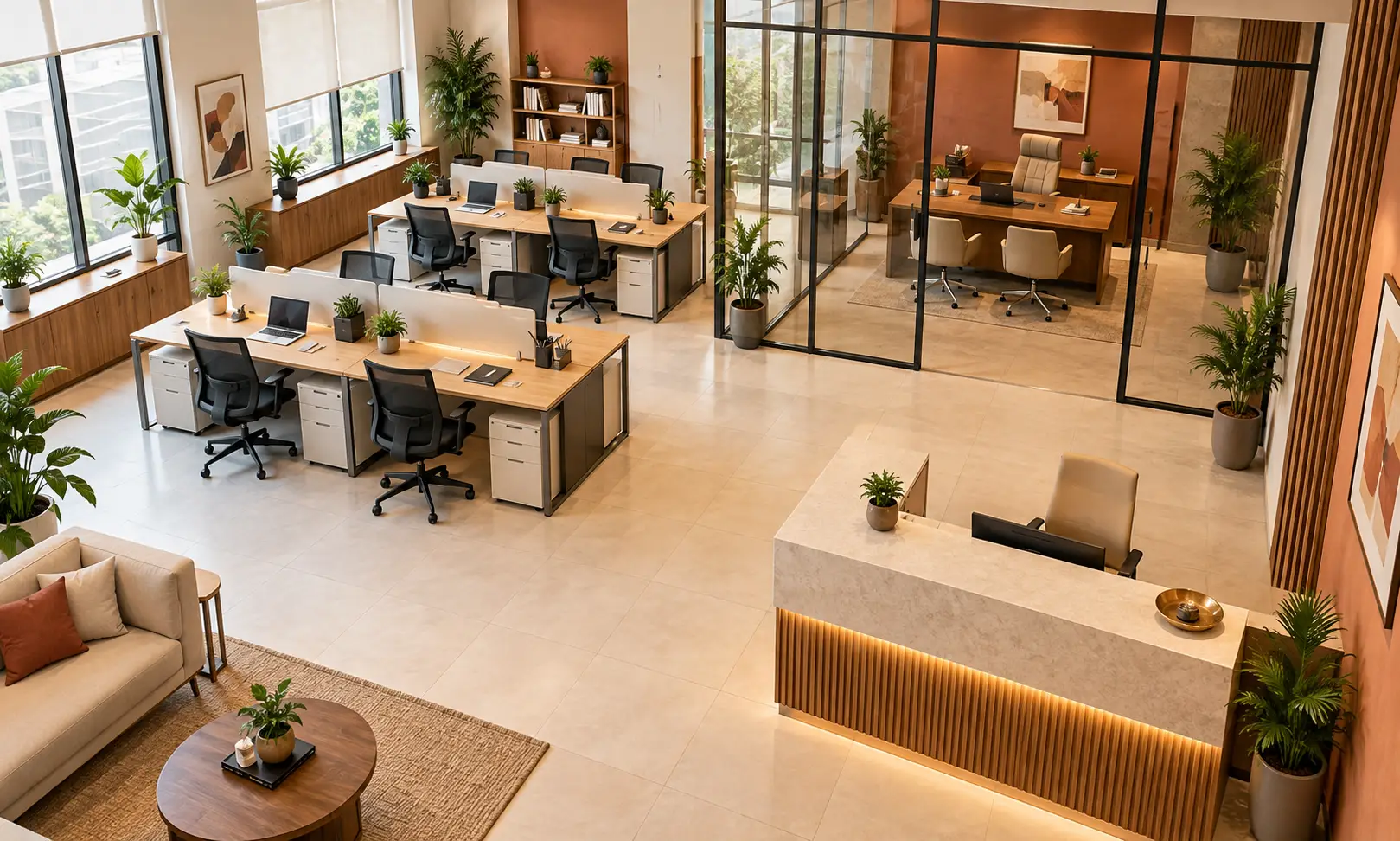
Of all commercial categories, offices are where corrections are typically easiest and least expensive, because most of what needs to change is furniture placement and seating orientation rather than construction. In a professional office audit we map every department, cabin and workstation against the directional grid, then produce a prioritised reallocation plan.
| Zone | Ideal Department / Use | Occupant Should Face | Supportive Elements |
|---|---|---|---|
| North | Reception, client meeting area, cash desk | South or East | Water feature, mirrors, blue or green tones |
| East | Sales, marketing, creative and product teams | North or East | Natural light, live plants, open sightlines |
| West | Accounts, HR, administration, records | North or East | Metal fittings, clocks, closed storage |
| South | Senior management, IT infrastructure, archives | North or East | Heavy furniture, solid walls, earthy tones |
| North-East | Boardroom, strategy room, quiet space | East or North | Light, clean open floor, minimal storage |
| South-East | Pantry, electrical panel, server room | East or North | Controlled fire element, good ventilation |
| South-West | Owner / director cabin, safe, heavy assets | North or East | Solid desk, wall support behind, weight |
| North-West | Networking, guest relations, dispatch | South-East or North | Movement, air circulation, communication devices |
The owner's or director's cabin
This is the single most consequential placement in an office. The ideal position is the South-West zone, with the occupant seated facing North or East, a solid wall directly behind for support, and a clear view of the cabin door without sitting in line with it. Three arrangements are corrected almost every time we encounter them: sitting with your back to the entrance, sitting directly beneath an exposed overhead beam, and sitting with a window immediately behind the chair instead of a solid wall. Each of these is associated in practice with decision fatigue and a persistent sense of working without backing.
Employee seating and productivity
Staff who face North or East while working generally report better focus, and teams seated in their function's matching zone tend to have lower friction. Workstations should not directly face a toilet door, should not be placed under exposed beams, and should not be arranged so that two employees sit back-to-back in a confined corner. For a quick self-check of your current arrangement, the free office seating tool gives a directional reading for individual desks.
Meeting rooms and boardrooms
Place decision-making rooms in the North-East wherever the layout permits. The senior-most participant should sit facing North or East with solid backing. Keep the room uncluttered — boardrooms quietly converted into overflow storage are a recurring finding in growing companies, and clearing them is among the least expensive corrections available.
Shop, Showroom & Retail Vastu: Turning Footfall Into Sales
Retail Vastu manages three zones in sequence — attraction at the entrance, engagement across the display area, and transaction at the billing counter. When these are misaligned, customers enter and browse but leave without purchasing, which is the single most common retail complaint we are called in for.

Retail is the category where the gap between footfall and conversion is most visible, and therefore where a well-executed audit tends to produce the clearest difference in day-to-day operations. Energy should move smoothly from the entrance, through the merchandise, to the billing point — without stagnating in a dead corner or reversing straight back out of the door.
Core retail placement principles
- Entrance in the North, East or North-East for maximum attraction and visibility
- Billing counter in the South-East or West zone — never directly facing the main entrance, which tends to push customers back out
- Cash drawer opening towards the North, the direction associated with wealth inflow
- High-value merchandise displayed in the West or South zones, which hold weight and value
- Fast-moving stock in the North and East, where movement energy is strongest
- Storage and surplus in the South-West or West — never in the North-East
- Staff positioning facing North or East while dealing with customers
- Mirrors placed to reflect merchandise and depth, never to reflect the entrance or the cash counter
- Lighting bright and even, with no persistently dark corner anywhere in the shopping area
Free preliminary shop check
Get an initial reading of your retail layout with the free shop Vastu check before committing to a full on-site audit.
Showrooms and large-format retail
Larger formats add a circulation dimension. Customer flow should ideally move clockwise through the space, with the highest-margin categories positioned along that natural path rather than tucked into a corner that traffic bypasses. Trial rooms belong in the South or West, never in the North-East. Escalators, staircases and lifts need careful placement; in multi-level showrooms this is often the most structurally significant finding of the audit.
Factory & Warehouse Vastu: Safety, Flow and Dispatch
In manufacturing and storage premises the governing principle is uninterrupted forward movement — raw material entering from the East or North, production anchored in the South-West, and finished goods dispatched towards the North-West. Reversed or stagnant flow tends to show up as pile-ups, breakdowns and safety incidents.
Industrial premises differ from offices and shops because the consequences of poor zoning are physical as well as commercial. Machinery placement, electrical layout, raw material storage and dispatch routing all carry safety implications alongside the energetic ones, so industrial audits are conducted with unusual care and always in coordination with your existing safety norms.
Production flow
Raw material enters from the East or North, moves through processing, and exits as finished goods towards the North-West. Flow should never double back on itself.
Machinery anchoring
Heavy machinery and load-bearing equipment belong in the South-West and South, the zones that carry weight and stability.
Fire and electricals
Boilers, furnaces, electrical panels and generator sets sit in the South-East, the fire zone, with proper ventilation.
Storage discipline
Bulk and slow-moving stock in the South and West; fast-moving inventory in the North and East; the North-East kept clear.
Administration block
Office and management functions in the North or East portion of the plot, kept distinct from the production zone.
Water and waste
Water storage in the North-East, waste handling and effluent towards the South or West, well away from the entrance.
Factories, warehouses and godowns are a separate discipline with their own requirements — plot orientation, shed alignment, machinery mapping, worker station planning — that we treat them as a separate discipline. If your premises is a manufacturing unit, godown or industrial plot, our dedicated industrial Vastu consultation covers that ground in far greater depth than this page can. For a quick preliminary reading, the free factory Vastu check is a useful starting point.
Commercial Vastu Guidance by Business Type
Different businesses have genuinely different energetic requirements, so a competent commercial Vastu consultant tailors recommendations to the specific business type rather than applying one generic template to every premises.
The table below summarises the critical zones we prioritise for the business types we are most often engaged for across Greater Noida and Delhi NCR. Treat it as an orientation, not a prescription — actual recommendations always follow the specific layout.
| Business Type | Critical Zones | Preferred Entrance | Owner / Manager Placement | Watch Out For |
|---|---|---|---|---|
| Restaurant / Cafe | Kitchen (SE), Dining (NE/N) | North or East | South-West, facing North | Kitchen in the North-East; billing facing the door |
| Retail shop / Showroom | Display (N/E), Billing (SE/W) | North or North-East | South-West, facing North | Storage in the North-East; dark corners |
| Clinic / Hospital | Consultation (NE), Treatment (NW/W) | East or North | South-West, facing East | Waiting area in the South-West; clutter in the NE |
| School / Coaching centre | Classrooms (NE/E), Library (W) | East or North-East | South-West, facing East | Students facing South while studying |
| IT / Software office | Servers (SE), Strategy (NE) | North or East | South-West, facing North | Servers in the North-East; pantry in the NE |
| Jewellery / High-value retail | Display (W/S), Safe (SW) | North or East | South-West, facing North | Safe in the North-East; mirrors facing the entrance |
| Warehouse / Godown | Bulk storage (S/W), Dispatch (NW) | North or East | North or East admin block | Heavy storage in the North-East; blocked dispatch route |
| Salon / Wellness centre | Treatment (NW/W), Reception (N) | North or East | South-West, facing North | Water and fire elements placed adjacent |
Cash Flow and Wealth Zones in a Commercial Premises
Financial energy in a commercial space operates through three zones — the North governs incoming cash flow, the South governs accumulation and assets, and the South-East governs transactions and margins. Businesses that optimise only one of the three commonly see healthy revenue but poor retained profit.
This is one of the more useful distinctions in commercial Vastu, because it maps neatly onto a problem many owners describe without being able to name it: money comes in, but nothing stays. In our experience that pattern usually points to a well-supported North zone combined with a compromised South or South-West — inflow is fine, accumulation is not.
North — inflow
Governs incoming revenue and new opportunity. Keep it light, clean and active. Cash handling and client-facing functions do well here.
South & South-West — accumulation
Governs savings, assets and retained profit. Needs weight and stability: safes, heavy furniture, solid walls.
South-East — transaction
Governs margins and the fire of exchange. Billing, electricals and the pantry belong here, kept in controlled balance.
Wealth-zone cautions
Avoid toilets, dustbins, broken furniture and dead electronics in the North zone. Never place a safe or cash locker so that it opens towards the South. Keep the North-East light and uncluttered, and keep the Brahmasthan — the centre of the premises — free of heavy fixed structures.
For the wider treatment of this subject beyond commercial premises, our guide to Vastu for wealth and prosperity goes into the underlying principles in more detail.
Common Commercial Vastu Dosh and Their Remedies
A Vastu dosh is a specific structural or placement imbalance that produces persistent, recurring problems. In commercial premises most dosh can be addressed through placement, elemental and symbolic corrections rather than demolition or structural alteration.
The table below lists the imbalances we encounter most frequently in commercial audits across Delhi NCR, along with the correction approach we typically prescribe. Severity matters: the same dosh in a small shop and a multi-floor office may warrant quite different responses.
| Vastu Dosh | Typical Business Symptoms | Correction Approach | Severity |
|---|---|---|---|
| Toilet in the North-East | Plans fail at the last step; poor clarity in decisions | Keep the door shut, apply corrective placement and elemental balancing; relocate the function when renovation allows | High |
| Kitchen or pantry in the North-East | Disputes, communication breakdown, restlessness | Shift to the South-East where possible; interim fire-element balancing | High |
| Owner seated facing the entrance or under a beam | Decision fatigue, stress, sense of working without support | Reposition seating with solid backing; false ceiling beneath exposed beams | Medium |
| Heavy storage in the North or North-East | Blocked opportunities, stalled expansion | Relocate weight to the South-West and West; keep the North-East light | Medium |
| Billing counter directly facing the main entrance | Customers leave quickly; low conversion despite footfall | Relocate the counter to the South-East or West zone | Medium |
| Cluttered or obstructed Brahmasthan | General stagnation across all functions | Clear the central area; remove heavy fixtures and stored material | High |
| Blocked or unlit main entrance | Weak lead flow; the business feels invisible | Clear the approach path, repair the threshold, correct the lighting | Low, quick to fix |
| Staircase descending towards the entrance | Outflow of resources; difficulty retaining gains | Placement and elemental corrections at the landing; visual separation | Medium |
Our non-demolition correction philosophy
Most businesses cannot afford structural demolition, and in the large majority of cases they do not need it. Our corrections work through three non-invasive layers. Elemental balancing uses the strategic placement of the five elements to compensate for a zone that cannot be physically changed. Colour and light adjustment shifts the character of a zone through finishes, lighting temperature and the placement of reflective surfaces. Symbolic remedies — yantras, sacred geometry and specific placements — are used where classical practice supports them, and only where they are genuinely indicated.
Every remedy we prescribe comes with the reasoning behind it, and is calibrated to your business type and the severity of the finding. We do not sell unnecessary products, and we do not prescribe expensive items where a placement change achieves the same result. Our full approach is set out on the non-demolition Vastu remedies page.
Commercial Vastu Consultant in Greater Noida, Noida Extension & Delhi NCR
BhagyaVastu operates from Greater Noida and serves commercial clients in person across Noida, Greater Noida West, Delhi, Ghaziabad, Gurugram and Faridabad, with on-site visits elsewhere in India by appointment and detailed online audits for clients anywhere in the world.
Working as a commercial Vastu consultant in Greater Noida and the wider NCR brings a particular familiarity with the building stock here, and that familiarity matters more than it might sound. Commercial property in this region has recognisable patterns — and recognising them quickly means an audit spends its time on what is specific to your premises rather than re-learning the basics.

Corporate towers in Tech Zone, Knowledge Park and along the Noida Expressway corridor tend to come with fixed service cores, predetermined toilet and lift positions and glass facades, which means entrance and seating corrections carry most of the weight. Retail units in Greater Noida West and the Noida Extension societies are usually compact, so billing placement and display flow matter disproportionately. Industrial premises around Surajpur, Kasna and the Ecotech sectors bring plot-orientation and production-flow questions to the front. Older commercial markets in Delhi and Ghaziabad frequently have shared walls and irregular plot shapes that need careful handling rather than textbook answers.
For clients in and around Greater Noida we generally recommend an on-site visit, since directional measurement taken in person is more reliable than measurement derived from a drawing. For clients further afield, a properly conducted online audit — based on an accurate floor plan with directions marked, supplemented by photographs and a detailed video walkthrough — is genuinely effective and follows exactly the same structured process.
Areas we serve
Our office: Golden I, T3-519, behind McDonalds, Tech Zone IV, Amrapali Leisure Valley, Greater Noida, Uttar Pradesh 201318. Visits by prior appointment.
Our Commercial Vastu Audit Process
A BhagyaVastu commercial audit runs through six stages — preliminary assessment, on-site or online measurement, analysis against business symptoms, a prioritised written report, implementation support and a follow-up review.
- Preliminary assessment. Before any visit we understand your business type, the premises layout and the specific challenges you are facing. This shapes what the audit focuses on and keeps the visit efficient.
- On-site or online audit. Directional measurement and zone-by-zone energy mapping of the premises. On-site visits include physical measurement; online audits work from an accurate floor plan with directions, photographs and a video walkthrough.
- Analysis. We correlate the directional findings with the actual business symptoms you described. This step separates a real audit from a checklist — the same misalignment matters more in one business than another.
- Prioritised report. You receive a written report with every correction marked Critical, Important or Optional, each with the reasoning behind it. You know what to do first and what can wait.
- Implementation support. Guidance while the changes are actually carried out, so corrections are executed correctly rather than approximately. This is the stage where most self-implemented Vastu advice fails.
- Follow-up review. A review after implementation to confirm the corrections were applied as intended, and to fine-tune anything that needs adjustment.
Commercial Vastu Consultation Fees
Commercial Vastu consultation at BhagyaVastu starts from ₹15,000. The final fee depends on the size and type of the premises and whether the audit is conducted on-site or online, and is quoted transparently before you commit.
COMMERCIAL VASTU AUDIT
The exact fee is decided by the size of your commercial space and its type — office, shop, showroom, restaurant, clinic or industrial unit — and whether you need an on-site visit or a detailed online audit. Share your premises details and you will receive a clear, itemised quote before anything is booked. No hidden charges, and no pressure to purchase remedial products.
What the fee covers: the full audit, the written prioritised report, the reasoning behind each recommendation, implementation guidance and a follow-up review. We are explicit about this because unclear pricing is one of the most common complaints people have about Vastu consultation generally, and it is easily avoided.
Get My Exact Quote Ask on WhatsAppYour Consultant: Dr. Kkomal Vasisht

Dr. Kkomal Vasisht — Ph.D. in Vedic Vastu (Gold Medalist), MBA, IAF-certified Vastu Consultant, Astrologer and Numerologist.
With 15+ years of practice and more than 15,000 consultations — including over 500 commercial spaces — Kkomal ji combines classical Vastu Shastra with the structured, analytical approach of a management background. Her work is characterised by clear reasoning for every recommendation, corrections that respect business continuity, and a refusal to use fear as a selling tool. Her guiding principle is simple: empower, never frighten.
What Our Commercial Clients Say
“Thanks Bhagya Vastu for correcting my office & home Vastu 🙏🏻”
“She is the best in her work. I have consulted her for my business and home vaastu. She entertained me with full dedication and provide vest solution for my problems that too in budget. I strongly recommend her.”
“Kkomal ma'am is one of the best Vastu Consultants in Delhi NCR. She had given us few suggestions for our new house and the results were amazing. Thank you”
“Excellent service. Punctual. Good Nature. Has an Excellent knowledge in the subject.”
“One of the finest Vastu consultant in Noida .... Thanks for helping Kkomal Vasisht ma'am 😊”
“It was really very good experience of getting entire vastu study and remedies for our home.”
Read all 159 reviews Write a Google Review
Related BhagyaVastu Services
Residential Vastu Consultation
Vastu audits for homes, flats and independent houses.
Industrial & Factory Vastu
Specialised audits for manufacturing units, warehouses and industrial plots.
Vastu for Business Growth
The strategic principles behind aligning a business with its space.
Non-Demolition Remedies
Corrections that work without structural changes or demolition.
Plot Selection as per Vastu
Assessment before you buy commercial land or premises.
Vastu for Wealth & Prosperity
Zone-wise guidance on cash flow, accumulation and margins.
Frequently Asked Questions
How do I choose a good commercial Vastu consultant in Greater Noida?
Do I need to demolish or make structural changes for commercial Vastu?
How much does a commercial Vastu consultation cost?
Do you offer online commercial Vastu consultation?
Which areas do you cover for on-site commercial Vastu visits?
Which direction should the owner sit in an office?
Where should the cash counter be placed in a shop?
Is a South or West facing commercial property bad as per Vastu?
How long does a commercial Vastu audit take?
Can commercial Vastu really improve my business finances?
Can Vastu corrections be done in a rented commercial space?
How is BhagyaVastu different from other commercial Vastu consultants?
Ready to Align Your Business Space?
If the patterns described on this page match what you are experiencing in your office, shop or unit, a structured commercial Vastu audit will give you a clear, prioritised roadmap — with practical corrections you can actually implement, and honest reasoning behind each one.
Book a Commercial Vastu Audit Quick Query on WhatsApp Contact UsDisclaimer: Vastu Shastra is a traditional Indian science of architecture and spatial design. The recommendations on this page and in our consultations are based on its classical principles combined with our field experience. Vastu creates supportive environmental conditions; it does not replace sound business strategy, product quality, regulatory compliance or professional management. BhagyaVastu provides consultation services only and does not guarantee specific business or financial outcomes. Results vary by premises, business type and the extent to which recommendations are implemented.