
Industrial Vastu Consultant in Greater Noida for Factories & Warehouses
Looking for an experienced industrial Vastu consultant in Greater Noida? BhagyaVastu, led by Dr. Kkomal Vasisht, audits factories, manufacturing units, warehouses and godowns across the Ecotech, Surajpur and Kasna industrial belts — with practical, no-demolition corrections that respect production schedules and existing safety norms.

What this guide covers
- Signs your unit needs a Vastu audit
- What industrial Vastu actually is
- Eight-direction map for industrial units
- Factory main gate direction
- Factory layout & production flow
- Machinery placement as per Vastu
- Warehouse & godown Vastu
- Factory office block
- Boiler, electrical & utilities
- Guidance by manufacturing type
- Industrial plot Vastu
- Vastu dosh & remedies
- Serving Greater Noida's industrial belt
- Frequently asked questions
An industrial unit is judged by numbers that are easy to measure — output per shift, rejection rate, downtime hours, dispatch turnaround. When those numbers behave strangely for no traceable reason, most owners look at the machines, the supervisors and the supply chain. Very few look at the building itself, and at how the plant is arranged inside it.
Industrial Vastu is the applied study of how a factory's orientation, zoning and internal flow affect production, safety and the people working inside. It is not ritual and it is not a substitute for maintenance or process control. It is an environmental discipline: place the right activity in the right zone, keep the material flow moving forward, and the plant stops fighting itself.
At BhagyaVastu we have carried out this work across more than 15,000 consultations over 15+ years, including manufacturing units, warehouses, godowns and industrial plots across Greater Noida and Delhi NCR. What follows is a detailed, zone-by-zone guide to how factory Vastu works, what an industrial Vastu consultant in Greater Noida examines during an audit, and what corrections realistically look like on a working shop floor.
Signs Your Factory or Unit Needs a Vastu Audit
An industrial Vastu audit is worth considering when operational problems repeat in a pattern that maintenance and process fixes do not resolve — recurring breakdowns in the same corner, pile-ups at the same stage, labour attrition, or dispatch delays that have no supply-chain explanation.
No single symptom proves a Vastu issue. What matters is the pattern: problems that recur in the same form, resist the obvious engineering fixes, and often cluster in one physical area of the plant.
- Machinery breaks down repeatedly in one specific area, despite servicing
- Production piles up at the same stage every cycle
- Skilled labour keeps leaving, or absenteeism stays stubbornly high
- Minor accidents and near-misses concentrate in one zone
- Dispatch is always late even when production finishes on time
- Payments from reliable buyers get delayed again and again
- Rejection and rework rates stay high with no process explanation
- Expansion plans stall at the last approval or funding step
- Disputes with labour, contractors or partners recur unusually often
Check your unit yourself, free
Before booking anything, get a preliminary reading with the free factory Vastu check and the direction finder tool. Both are free and establish your plot's true facing direction — where every industrial audit begins.
What Is Industrial Vastu — and Why It Differs from Office Vastu
Industrial Vastu applies Vastu Shastra to manufacturing and storage premises with a focus on uninterrupted production flow, machinery stability, worker safety and dispatch movement — unlike office or retail Vastu, which is tuned for decisions, client experience and transactions.
The difference is practical, not theoretical. An office needs clear decision zones and stable authority placement. A shop needs attraction and transaction energy. A factory needs something else entirely: forward movement that never reverses. Raw material enters, moves through processing, and leaves as finished goods. When that flow doubles back on itself, or stagnates in a dead corner, the symptoms show up as pile-ups, rework and breakdowns.
Industrial premises also carry a consequence that offices do not: the corrections have safety implications. Machinery placement, electrical layout, boiler positioning and dispatch routing all sit at the intersection of Vastu and plant safety. For that reason every audit we conduct as an industrial Vastu consultant in Greater Noida is coordinated with your existing safety norms — we never recommend a change that compromises them.
The most common mistake
Applying office or retail Vastu advice to a plant. Arrangements that work in a showroom can obstruct the directional material flow a factory depends on. Industrial premises must be assessed by production function, never treated as a large office.
If your premises is an office, shop or showroom rather than a plant, our commercial Vastu consultation covers that ground instead.
The Eight-Direction Map for Industrial Units
In industrial Vastu each direction governs a specific plant function — the South-West anchors heavy machinery, the South-East holds fire and power, the North-West carries dispatch and movement, and the North-East stays light for planning and water.
Every factory audit begins here. We overlay a directional grid on your plot and building plan, map what currently occupies each zone, and compare it against what that zone supports. Most correction lists come directly from the mismatches this exposes.
| Direction | Element / Governs | Ideal Industrial Use | Issues When Misaligned |
|---|---|---|---|
| North | Water · cash flow, opportunity | Accounts, cash handling, client reception, water source | Payment delays; blocked orders |
| East | Air · growth, new work | Raw material entry, R&D, sampling, admin | Weak order inflow; stalled development |
| West | Space · gains, systems | Finished goods, packing, stores, QC records | Process failures; inventory errors |
| South | Earth · strength, reputation | Heavy machinery, archives, senior cabins | Equipment instability; reputation issues |
| North-East | Water · clarity, planning | Planning room, water storage, open space, first-aid | Poor decisions; recurring worker health issues |
| South-East | Fire · energy, power | Boiler, furnace, electrical panel, DG set, canteen | Power faults, fire risk, disputes |
| South-West | Earth · stability, foundation | Heaviest machinery, owner's cabin, main stores | Weak footing; instability at the top |
| North-West | Air · movement, dispatch | Finished goods dispatch, loading bay, transport office | Slow dispatch; stock that will not move |
Two zones matter disproportionately in industrial premises. The North-East must stay light and open — burying it under heavy machinery, a scrap yard or an effluent tank correlates in practice with muddled planning and persistent worker health complaints. The Brahmasthan, the centre of the plot, should stay free of heavy fixed structures; in a shed layout this usually means keeping the central bay clear of the heaviest installations. The free Brahmasthan checker gives you a quick read on this.
Factory Main Gate Vastu Direction
The factory main gate is the primary channel through which orders, material and workers enter. Its direction, width, approach road and what stands directly opposite are assessed in every industrial Vastu audit.
In a plant the gate carries more weight than in any other building type, because everything physically passes through it — inbound raw material, outbound finished goods, labour, buyers and inspectors. Six factors are examined.
What we assess at the factory gate
- Direction — North, East and North-East gates generally support inflow; other orientations are balanced through pada placement rather than being rejected
- Pada placement — the exact position of the gate within the facing wall, which matters more than the facing direction itself
- Width and proportion — the main gate should be the widest opening, sized for the heaviest vehicle that uses it
- Approach road — clear, with no transformer, pole, sharp corner or dead-end directly facing the gate
- Immediate internal view — what a visitor sees first; a scrap heap, an effluent tank or a toilet block directly opposite the gate is always corrected
- Separation of flows — inbound raw material and outbound dispatch should ideally not share a single congested route
Quick gate principle
A South or West facing industrial plot is not a problem in itself. Many well-performing units in the Greater Noida industrial belt face South or West — what matters is that the gate sits in a favourable pada and the internal zoning is correct.
Vastu for Factory Layout and Production Flow
Vastu for factory layout follows one governing principle — uninterrupted forward movement. Raw material enters from the East or North, moves through processing anchored in the South and South-West, and exits as finished goods toward the North-West.
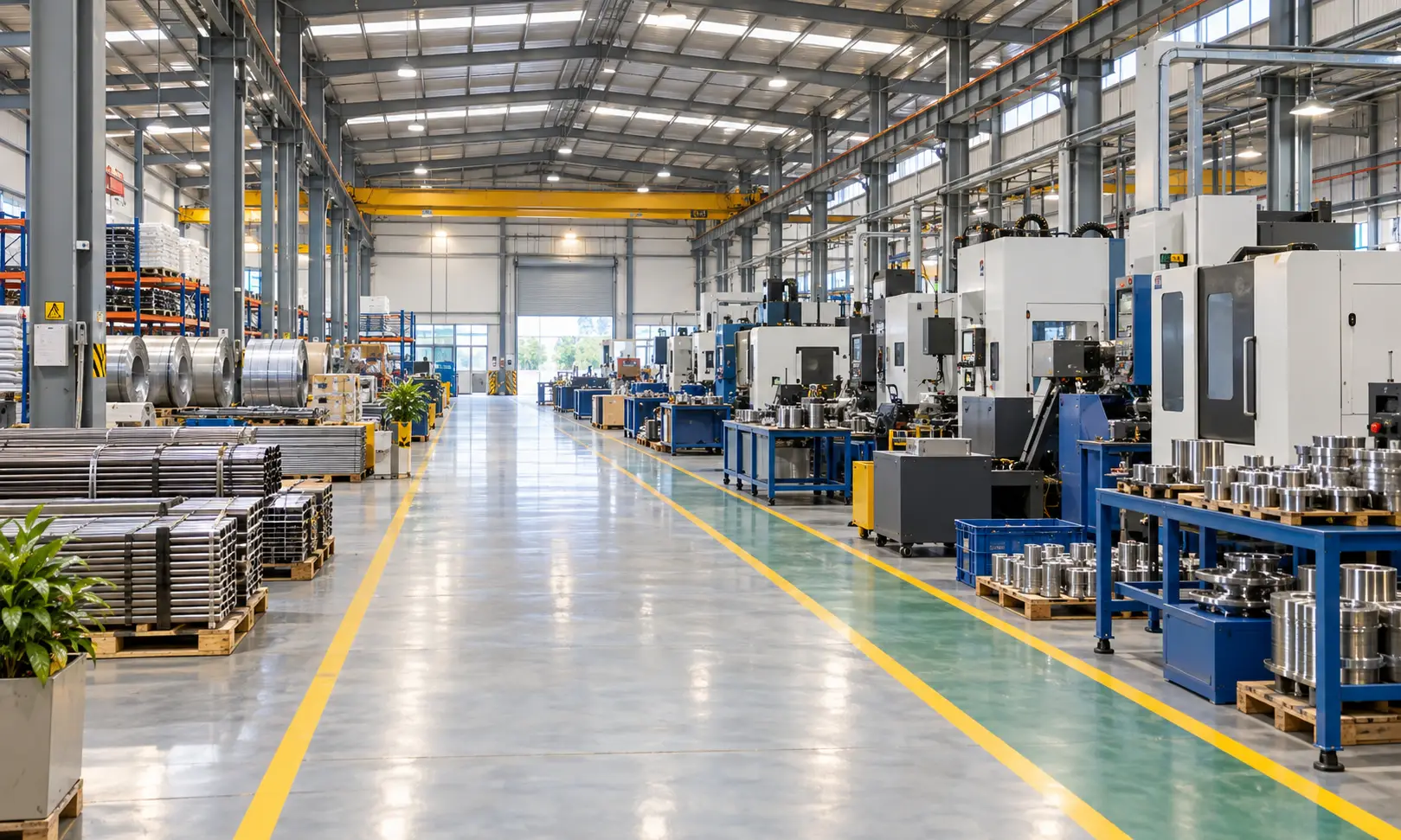
When we audit a plant layout, the first thing we trace is the path a single unit of material takes from gate to dispatch. In a well-aligned unit that path moves steadily in one direction. In a struggling unit it usually crosses itself two or three times — and every crossing point is a place where work-in-progress accumulates.
| Stage | Ideal Zone | Why | Common Error |
|---|---|---|---|
| Raw material entry & storage | East or North | Inflow zones; keeps material moving in | Raw material dumped in the North-West |
| Primary processing | South-East to South | Fire and strength zones drive transformation | Heavy processing in the North-East |
| Heavy machinery | South-West and South | Earth zones carry weight and stability | Heaviest machine in the North-East corner |
| Assembly / finishing | West | Zone of gains and completion | Finishing scattered across the floor |
| Quality control | North or North-East | Clarity zone supports judgement | QC bench next to the boiler |
| Finished goods store | North-West or West | Movement zone; stock leaves quickly | Finished goods in the South-West — stock sits |
| Dispatch / loading bay | North-West | Air zone governs outward movement | Dispatch blocked behind production |
The single most common industrial finding
Finished goods stored in the South-West. The South-West is a zone of weight and retention — excellent for machinery and stores, poor for stock that needs to leave. Units with this arrangement frequently report inventory that "sits" without a demand-side explanation. Relocating finished goods to the North-West is one of the cheapest and most effective corrections available.
Vastu for Factory Machinery Placement
Machinery placement as per Vastu follows weight and function — the heaviest and most static equipment belongs in the South-West and South, fire-driven equipment in the South-East, and lighter or frequently moved equipment toward the North and East.
Machinery is the one element in a plant that cannot be casually moved, which is why we assess it early and recommend changes only where the gain justifies the disruption. Where relocation is not feasible, elemental and placement corrections around the machine achieve a substantial part of the benefit.
| Equipment Type | Ideal Zone | Orientation | Avoid |
|---|---|---|---|
| Heaviest machinery (presses, CNC, lathes) | South-West, South | Operator facing North or East | North-East placement |
| Furnace, boiler, heat treatment | South-East | — | North-East or North-West |
| Generator set / electrical panel | South-East | — | North-East |
| Compressors & pumps | South or West | — | Brahmasthan (centre) |
| Light assembly machines | North-West, West | Operator facing North or East | Blocking the dispatch route |
| Testing & measuring equipment | North, North-East | Operator facing East | Adjacent to heat sources |
| Overhead cranes / conveyors | Aligned to the forward flow | Movement toward North-West | Reversing flow back toward the gate |
Worker stations and safety
Operators working long shifts do better facing North or East. Workstations should not sit directly under exposed beams, should not face a toilet block, and should not be placed so that two workers stand back to back in a confined corner. First-aid and emergency assembly points belong in the North-East, which is also the zone we recommend keeping physically clear for that reason.
Warehouse and Godown Vastu
A warehouse Vastu consultant assesses storage by weight and turnover — heavy and slow-moving stock in the South and West, fast-moving stock in the North and East, the North-East kept clear, and the dispatch bay toward the North-West.
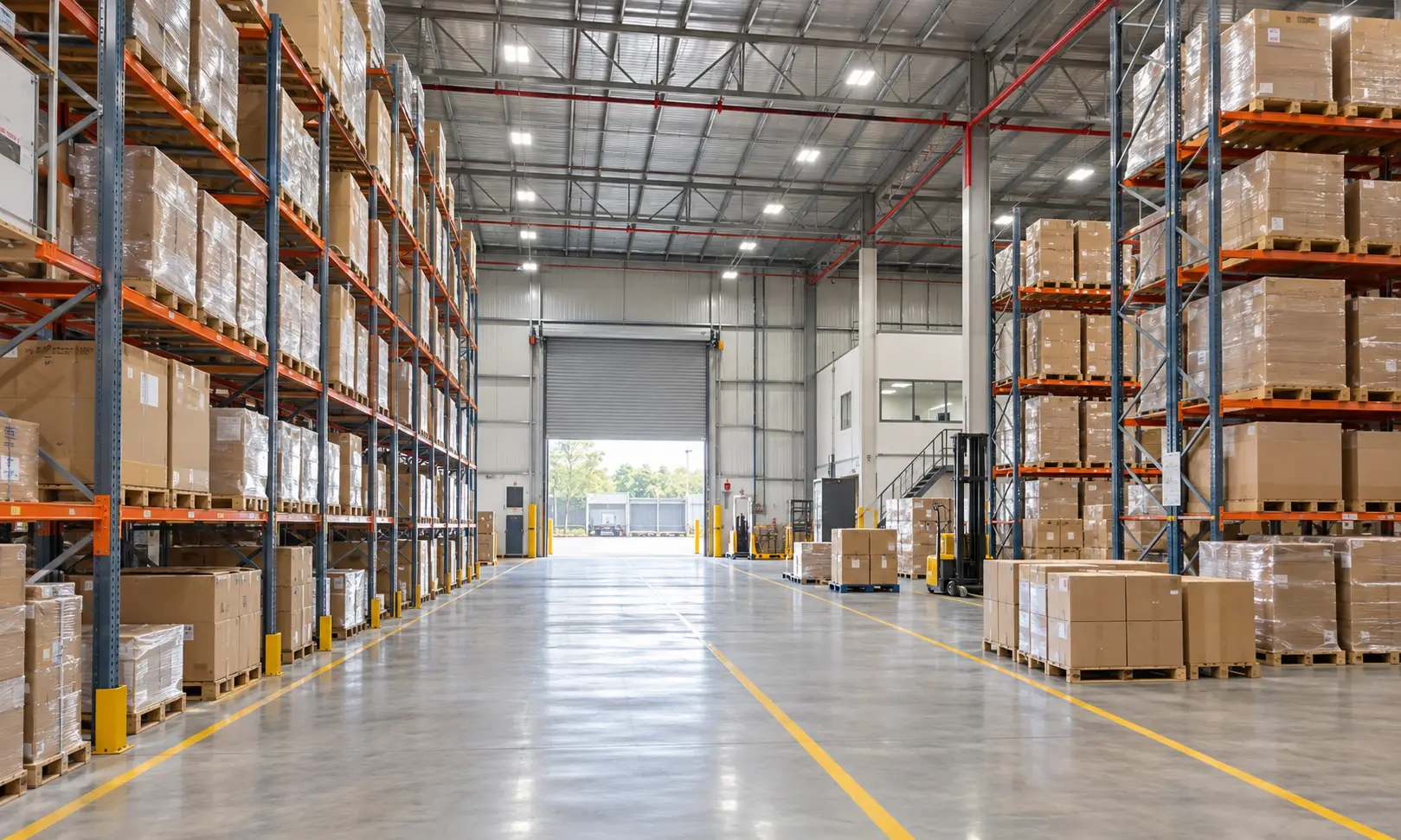
Warehouses and godowns are simpler than factories in one respect — there is no transformation, only movement and storage — and that makes the Vastu logic unusually clear. Everything comes down to what sits where, and whether stock can leave as easily as it arrived. This is the work a warehouse Vastu consultant does most often, and it is also the quickest category to correct.
Godown Vastu tips that apply to almost every unit
These are the corrections a warehouse Vastu consultant checks first, and most of them cost nothing to implement.
- Heavy and slow-moving stock in the South and West — these zones hold weight well
- Fast-moving stock in the North and East, closest to the movement zones
- North-East kept clear — no racking, no scrap, no stacked pallets
- Dispatch and loading bay toward the North-West
- Brahmasthan kept open — the central aisle rather than a stacking zone
- Damaged and rejected goods cleared regularly, never allowed to accumulate in a corner
- Office and records in the North or East portion
- Water storage in the North-East; toilets and waste toward the North-West or South
- Lighting even throughout — a permanently dark corner is where dead stock collects
Watch for this in godowns
Stock stacked high in the North-East and a cluttered central aisle are the two most common findings in leased godowns. Both are correctable within a day, cost nothing, and are the first things we address.
Vastu for the Factory Office Block
The administrative block of an industrial unit should sit in the North or East portion of the plot, kept distinct from the production area, with the owner's cabin in the South-West of the block facing North or East.
Most plants run a small office alongside the shop floor — accounts, despatch paperwork, buyer meetings, the owner's cabin. Its placement matters because it governs the commercial side of the business rather than the production side.
Owner / director cabin
South-West of the block, seated facing North or East, solid wall behind, clear view of the door.
Accounts & finance
North or West. Cash handling and the safe do well in the North; the safe should open toward the North.
Buyer meeting room
North-East or North — the clarity zone supports negotiation and agreement.
Despatch & logistics desk
North-West, close to the loading bay it coordinates.
HR & records
West — the zone of systems and documentation.
Canteen / pantry
South-East, the fire zone, with proper ventilation.
For a deeper treatment of office zoning, seating and department placement, see our commercial Vastu consultation page, and try the free office seating tool for individual desks.
Boiler, Electrical Panel and Utility Placement
Boiler and electrical panel Vastu places all fire and power equipment in the South-East, water storage in the North-East, and effluent or waste handling toward the North-West or South — never in the North-East.
This is the area where Vastu and plant safety overlap most directly, and where we are most careful. The South-East is the fire zone and the natural home for boilers, furnaces, DG sets, transformers and main electrical panels. Placing fire equipment in the North-East is a classic industrial dosh, and in practice these units report recurring electrical faults and a higher incidence of minor fire incidents.
| Utility | Ideal Zone | Avoid | Note |
|---|---|---|---|
| Boiler / furnace | South-East | North-East, North-West | Ventilation and clearance per safety norms first |
| Electrical panel / DG set | South-East | North-East | Keep the area dry and accessible |
| Transformer | South-East, South | Directly facing the main gate | Screening helps where relocation is impossible |
| Underground water tank | North-East | South-West | A South-West water tank is a significant dosh |
| Overhead tank | West or South-West | North-East | Opposite logic to the underground tank |
| Effluent / waste treatment | North-West or South | North-East | Keep well away from the gate and water source |
| Scrap yard | South or South-West | North-East, near the gate | Clear regularly; never let it become permanent |
| Toilets / worker facilities | North-West or West | North-East, South-West | Keep doors closed, ventilation working |
Vastu Consultant for Manufacturing Unit — Guidance by Industry Type
Different manufacturing types have different critical zones — heat-intensive units depend on the South-East, assembly units on forward flow, food units on strict North-East hygiene zones, and storage-heavy units on dispatch placement.
As a Vastu consultant for a manufacturing unit, we tailor recommendations to what the plant actually does rather than applying one template. The table below covers the unit types we are most often engaged for across the Greater Noida industrial belt.
| Unit Type | Critical Zones | Priority Correction | Watch Out For |
|---|---|---|---|
| Heat / foundry / forging | South-East (fire), South-West (machinery) | Fire equipment consolidated in the South-East | Furnace in the North-East |
| Assembly & fabrication | Forward flow East → West → North-West | Straighten the material path | Flow crossing itself twice |
| Food processing | North-East (hygiene, water), South-East (cooking) | Water source and cleanliness in the North-East | Waste handling near the North-East |
| Textile & garment | West (finishing), North-West (dispatch) | Finished stock moved out of the South-West | Fabric stock piled in the North-East |
| Plastic & injection moulding | South-East (heat), South (presses) | Moulding machines anchored South/South-West | Granule storage blocking the North-East |
| Auto components | South-West (heavy), North (QC) | QC in the clarity zone | Rejects accumulating near dispatch |
| Warehouse / 3PL | South & West (storage), North-West (dispatch) | Turnover-based zoning | Slow stock in fast zones |
| Packaging & printing | West (finishing), South-East (power) | Ink and solvent storage away from the North-East | Central aisle used for stacking |
Industrial Plot Vastu — Assessment Before You Buy or Build
Industrial plot Vastu assesses shape, slope, road position, surrounding structures and open-space distribution before construction begins — the stage at which corrections cost nothing because nothing has been built yet.
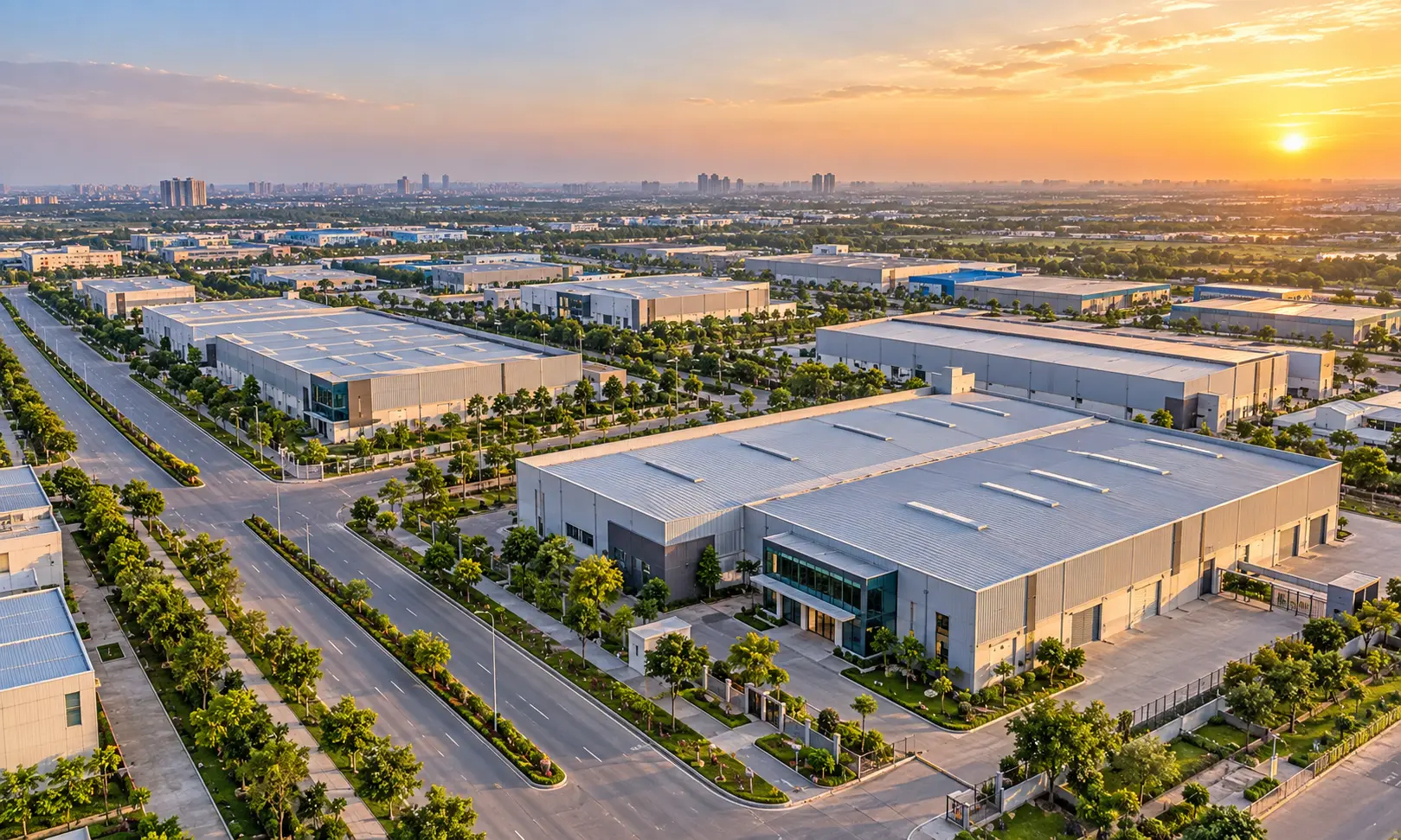
This is the single highest-value stage at which to involve a consultant. Once sheds are built and machinery is foundation-mounted, the options narrow considerably. At plot stage, everything is still a drawing.
Plot shape
Regular square or rectangular plots are preferred. Extended North-East corners are favourable; cut corners need correction.
Slope & level
Slope toward the North or East is favourable. The South-West should be the highest and heaviest part of the plot.
Road position
North and East facing roads generally support inflow. Corner plots need careful gate placement.
Open space
More open space in the North and East; more built mass in the South and West.
Surroundings
What stands on the adjoining plots — a transformer, chimney or effluent unit alongside the North-East needs planning around.
Shed alignment
The built structure aligned true to the cardinal grid wherever the plot permits.
Use the free plot check tool for a preliminary reading, and see our detailed guide on plot selection as per Vastu.
Industrial Vastu Dosh and No-Demolition Remedies
Most industrial Vastu dosh are addressed through relocation of movable elements, elemental balancing and placement corrections — not through demolition, which is rarely practical in a running plant.
A working factory cannot be shut down for structural work, and we plan around that. The table below lists the imbalances we encounter most often in units across Delhi NCR, along with the correction approach.
| Vastu Dosh | Typical Symptoms | Correction Approach | Severity |
|---|---|---|---|
| Heavy machinery in the North-East | Poor planning, recurring worker health issues | Relocate lighter equipment first; elemental balancing where the machine is fixed | High |
| Boiler or furnace in the North-East | Electrical faults, fire incidents, disputes | Shift fire equipment to the South-East over the next maintenance window | High |
| Finished goods in the South-West | Stock that will not move; slow dispatch | Relocate to the North-West — usually free | Medium |
| Underground water tank in the South-West | Financial instability, weak footing | Relocate where feasible; balancing where not | High |
| Scrap or effluent near the North-East | Stagnation, health complaints, blocked growth | Clear and relocate to the South or North-West | Medium |
| Blocked or obstructed Brahmasthan | General stagnation across all functions | Clear the central bay of heavy fixed installations | High |
| Dispatch route blocked behind production | Late dispatch despite on-time production | Re-route; separate inbound and outbound paths | Medium |
| Gate facing a transformer or pole | Recurring obstruction in orders and approvals | Screening, threshold correction, symbolic remedies | Low, quick to fix |
Vastu remedies for a factory without demolition
Our corrections work through three non-invasive layers. Relocation of movable elements — stock, light equipment, scrap, storage and workstations — usually delivers the largest share of the benefit and costs almost nothing. Elemental balancing compensates for zones that cannot be physically changed, such as a foundation-mounted machine or a builder-fixed shed opening. Symbolic remedies, including yantras and specific placements, are used where classical practice supports them and only where genuinely indicated.
Every recommendation comes with its reasoning, is calibrated to the severity of the finding, and is sequenced so that the free corrections happen first. Our full approach is set out on the non-demolition Vastu remedies page.
Industrial Vastu Consultant in Greater Noida's Factory Belt
BhagyaVastu operates from Tech Zone IV in Greater Noida and serves industrial units across the Ecotech sectors, Surajpur, Kasna, Site-IV and Site-V, with on-site visits across Delhi NCR and elsewhere in India by appointment.
Working as an industrial Vastu consultant in Greater Noida means working in one of North India's denser manufacturing belts, and the building stock here has recognisable patterns. Recognising them quickly means an audit is spent on what is specific to your unit rather than re-establishing the basics.
The Ecotech sectors are largely allotment plots with standard shed construction, which means gate pada placement and internal zoning carry most of the weight — the shell is rarely changeable, the contents almost always are. Units around Surajpur and Kasna tend to be older and larger, often expanded piecemeal over the years, which is where material flow most commonly crosses itself. Site-IV and Site-V in Noida hold a mix of light manufacturing and warehousing, where dispatch placement and storage turnover matter more than heavy machinery zoning. Units along the Eastern Peripheral corridor are typically logistics-heavy, where gate width, vehicle movement and loading-bay direction dominate the assessment.
For units within Greater Noida and Noida we strongly recommend an on-site visit — industrial premises are the one category where a drawing genuinely does not substitute for walking the floor. Machinery positions, flow bottlenecks and utility placements are best read in person. For units elsewhere in India, a detailed online audit based on plant drawings, photographs and a video walkthrough is available and follows the same process.
Areas we serve
Our office: Golden I, T3-519, behind McDonalds, Tech Zone IV, Amrapali Leisure Valley, Greater Noida, Uttar Pradesh 201318. Visits by prior appointment.
Our Industrial Vastu Audit Process
A BhagyaVastu industrial audit runs through six stages — preliminary assessment, on-site measurement and flow mapping, analysis against operational symptoms, a prioritised written report, phased implementation support, and a follow-up review.
- Preliminary assessment. We understand your industry type, plant layout, shift pattern and the specific operational problems you are facing, so the visit is focused from the first minute.
- On-site audit. Directional measurement, machinery mapping and a full trace of the material flow from gate to dispatch. Conducted around your production schedule, not against it.
- Analysis. We correlate the directional findings with the actual operational symptoms — breakdown locations, pile-up points, attrition patterns — rather than issuing a generic checklist.
- Prioritised report. A written report marking each correction Critical, Important or Optional, with its reasoning, and sequenced so that zero-cost changes come first.
- Phased implementation. Changes planned around maintenance windows and shutdowns so production is not disrupted. We coordinate with your plant team and existing safety norms.
- Follow-up review. A review after implementation to confirm corrections were applied as intended and to fine-tune anything that needs adjustment.
Industrial Vastu Consultation Fees
Industrial Vastu consultation fees depend on the size of the plot and built area, the type of unit, and whether the audit is conducted on-site or online. You receive a clear, itemised quote before anything is booked.
INDUSTRIAL VASTU AUDIT
The fee is decided by your plot and built-up area, the type of unit — factory, manufacturing plant, warehouse or godown — and whether you need an on-site visit or a detailed remote audit. Share your unit details and you will receive a clear, itemised quote before you commit. No hidden charges, and no pressure to purchase remedial products.
What the fee covers: the full on-site audit, the written prioritised report, the reasoning behind every recommendation, phased implementation guidance and a follow-up review.
Get My Quote Ask on WhatsAppYour Consultant: Dr. Kkomal Vasisht

Dr. Kkomal Vasisht — Ph.D. in Vedic Vastu (Gold Medalist), MBA, IAF-certified Vastu Consultant, Astrologer and Numerologist.
With 15+ years of practice and more than 15,000 consultations, Kkomal ji combines classical Vastu Shastra with the structured, analytical approach of a management background — which matters particularly in industrial work, where recommendations have to fit production realities. Her approach is characterised by clear reasoning for every recommendation, phased corrections that respect plant schedules, and a refusal to use fear as a selling tool. Her guiding principle is simple: empower, never frighten.
What Our Business Clients Say
“Thanks Bhagya Vastu for correcting my office & home Vastu 🙏🏻”
“She is the best in her work. I have consulted her for my business and home vaastu. She entertained me with full dedication and provide vest solution for my problems that too in budget. I strongly recommend her.”
“Excellent service. Punctual. Good Nature. Has an Excellent knowledge in the subject.”
“Always have proper guidance and solutions to your problems. Very patient and professional.”
“One of the finest Vastu consultant in Noida .... Thanks for helping Kkomal Vasisht ma'am 😊”
“She is a very experienced and a full of knowledgeable person. Highly impressed with her knowledge and solutions. I will surely recommend her to all my friends and family.”
Read all 159 reviews Write a Google Review
Related BhagyaVastu Services
Commercial Vastu Consultation
Offices, shops, showrooms and business premises.
Residential Vastu Consultation
Homes, flats and independent houses.
Plot Selection as per Vastu
Assessment before you buy industrial land.
Vastu for Business Growth
The strategic principles behind aligning a business.
Non-Demolition Remedies
Corrections that work without structural change.
Vastu for Wealth & Prosperity
Cash flow, accumulation and margin zones.
Frequently Asked Questions
How do I choose a good industrial Vastu consultant in Greater Noida?
Do I need to stop production for a factory Vastu audit?
Which direction should the factory main gate face?
Where should heavy machinery be placed as per Vastu?
Why does my finished stock not move?
Where should the boiler and electrical panel be?
Do you audit warehouses and godowns as well as factories?
Can Vastu corrections be done in a leased industrial unit?
Should I consult before buying an industrial plot?
Which areas do you cover for industrial site visits?
Can industrial Vastu improve production output?
How is BhagyaVastu different from other industrial Vastu consultants?
Ready to Align Your Plant?
If the patterns on this page match what you are seeing on your shop floor, a structured industrial Vastu audit will give you a clear, prioritised roadmap — starting with the corrections that cost nothing. Book an audit with an experienced industrial Vastu consultant in Greater Noida and begin where the impact is highest.
Book a Factory Vastu Audit Quick Query on WhatsApp Contact UsDisclaimer: Vastu Shastra is a traditional Indian science of architecture and spatial design. The recommendations on this page and in our consultations are based on its classical principles combined with our field experience. Vastu creates supportive environmental conditions; it does not replace plant maintenance, process control, statutory safety compliance or professional management, and no recommendation should be implemented in a way that conflicts with your safety norms or regulatory obligations. BhagyaVastu provides consultation services only and does not guarantee specific operational or financial outcomes.